Introduction
Black mass sampling presents specific challenges in battery recycling due to the heterogeneous composition and variable physical properties of the recovered material. Mechanical processing of spent lithium-ion batteries and battery manufacturing waste produces an intermediate material known as black mass. Depending on the recycling process, it may contain cathode active materials, graphite, lithium compounds, conductive additives, and residual fractions of aluminium, copper, plastics, or other components.
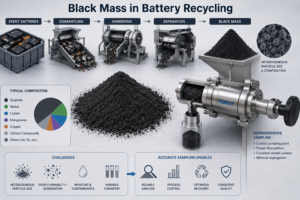
Unlike a newly manufactured cathode or anode powder, black mass does not have one fixed composition. Its properties depend on:
- The battery chemistries entering the recycling process
- The proportion of production scrap and end-of-life batteries
- Dismantling and shredding conditions
- Drying, sieving and separation stages
- Contamination introduced during collection or processing
Differences in particle size, density and composition can cause segregation during conveying, storage and hopper discharge. A small sample collected from only one location may therefore fail to represent the complete material stream or batch.
Representative black mass sampling is important when laboratory analysis determines composition, impurities, recovery potential or downstream recycling performance.
This technical application note examines process sampling of black mass while addressing heterogeneity, segregation, abrasive behaviour, powder containment and the need for multiple sampling increments.
The characteristics of black mass vary significantly between recycling facilities. The final sampling method must therefore be based on the actual material and process rather than on the designation “black mass” alone.
Sources: European Commission Joint Research Centre, Technical Suggestions for Recycling Efficiency and Material Recovery Rules, December 2024 and van de Ven et al., Scientific Reports, 2024
The Application
This application considers black mass transferred after shredding, drying and mechanical separation towards storage or downstream recycling.
Quality-control laboratories may analyse samples to determine:
- Tithium, nickel, cobalt and manganese content
- Graphite concentration
- Aluminium and copper residues
- Moisture content
- Particle size distribution
- Other impurities
The sampling point may be located:
- Below a separator or sieve
- On a hopper outlet
- Along a gravity transfer line
- Before filling a container or big bag
The objective is to collect material while it is moving and to obtain several increments across the transfer. The facility may analyse these increments separately or combine them into a composite sample according to its sampling plan.
A single surface sample provides information only about that location and does not automatically represent the complete batch.
💡Engineering Insight
For heterogeneous black mass, several correctly timed increments are generally more informative than one large sample collected at a single moment.
Black Mass Sampling Challenges
Black mass can contain particles with different sizes, shapes, densities and chemical compositions. These differences may cause segregation during vibration, conveying, storage and discharge.
The main sampling challenges include:
- Variation in composition across the material stream
- Separation of fine and coarse fractions
- Inconsistent chamber filling
- Abrasive wear on product-contact surfaces
- Powder retention and cross-contamination
- Dust release during sample recovery
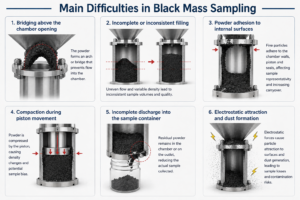
The material may also contain residual reactive components or hazardous substances. The required containment and safety measures must therefore be based on the facility’s material characterisation and risk assessment.
💡Engineering Insight
A sample can have the correct mass but still be unrepresentative if it contains the wrong proportion of fine, coarse, light or dense particles.
Representative Sampling Strategy
The sampler should be positioned where it can access moving material rather than a stagnant zone inside a hopper or container.
For a batch transfer, several increments should be collected:
- near the beginning
- at defined intervals during the transfer
- near the end
The increments may be analysed individually to identify variation or combined into a composite sample representing the batch.
The sampling frequency, increment size and combination method should be defined according to the batch size, material variability and laboratory requirements.
💡Engineering Insight
Representative black mass sampling depends more on where and when increments are collected than on the total mass of one individual sample.
Engineering Considerations for Black Mass Sampling
A DN50 FAMAT sampling valve may be considered to provide a larger opening for heterogeneous material and coarse particles.
The proposed configuration should include:
- Installation on a hopper outlet or gravity transfer line
- A sampling chamber suited to the required increment mass
- Several automated or manual sampling cycles during transfer
- A short discharge path
- A closed receiving container
- Accessible product-contact areas for inspection and cleaning
For a vertical gravity chute, an intrusive sampler may also be evaluated to collect material directly from the moving stream.
Contact materials and surface treatments must be selected according to the actual abrasiveness, composition and contamination limits of the black mass.
💡Engineering Insight
Collecting several smaller increments with a repeatable valve cycle may provide a more representative sample than attempting to fill one oversized chamber.
Testing and Validation
Testing should be performed with representative black mass before finalising the sampling configuration.
The test should verify:
- Chamber filling and discharge
- Consistency of collected mass
- Representation of fine and coarse fractions
- Powder retention
- Wear on product-contact surfaces
- Containment during sample recovery
- Cleaning between batches
Samples collected at different stages of the transfer should also be compared. Significant differences may indicate segregation and the need for additional increments.
💡Engineering Insight
Validation should confirm not only that the valve collects material, but that each increment reflects the composition of the moving black mass stream.
Conclusion
Representative black mass sampling requires a method that accounts for material heterogeneity, segregation and potential abrasive behaviour.
The main considerations are:
- Sampling from moving material
- Collecting several increments across the transfer
- Selecting an appropriate chamber size
- Controlling dust during sample recovery
- Monitoring wear and powder retention
- Validating the system with the actual material
A single sample collected from one location may not represent the complete batch. The sampling valve, sampling frequency and laboratory preparation method must therefore form one consistent sampling plan.
Discuss Your Black Mass Sampling Application
FAMAT Sampling can review the material characteristics, process geometry, required sample quantity and containment conditions to define an appropriate testing and sampling configuration.
Contact FAMAT Sampling to discuss your battery recycling and black mass sampling application.