Table of Contents
ToggleIntroduction
Dairy powder sampling requires careful consideration of powder behaviour, product value, hygiene and the risk of cross-contamination between production batches.
Dairy ingredients can include milk powders, whey-based ingredients, protein concentrates, protein isolates and other specialized powdered products. Their physical behaviour can vary considerably depending on composition, particle size, moisture content and manufacturing conditions.
For high-value dairy ingredients, laboratory analysis may support decisions related to composition, moisture, protein content, particle characteristics or batch consistency. The usefulness of these results depends partly on the quality of the sample submitted to the laboratory.
A sampling system should therefore collect material from a relevant process location while limiting unnecessary product exposure and retention within the sampling path.
Dairy Powder Sampling Considerations
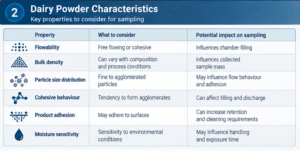
Powder behaviour also influences the sampling operation. Some dairy powders flow relatively freely, while others may show cohesive behaviour, adhere to surfaces or compact inside a sampling chamber.
The sampling strategy should consider:
- Powder Flowability
- Bulk Density
- Particle Size Distribution
- Cohesive Behaviour
- Product Adhesion
- Moisture Sensitivity
- Sampling Chamber Filling
- Complete Sample Discharge
- Hygienic Design
- Cleaning Requirements
These characteristics help determine the appropriate sampling configuration and whether trials with the actual powder are necessary.
💡 Engineering Insight
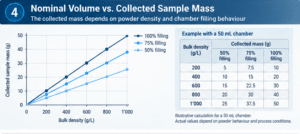
A defined sampling chamber provides a nominal volume, not a guaranteed sample mass. Powder density, flowability and chamber-filling behaviour determine how much material enters the chamber during each sampling cycle.
Why High-Value Dairy Powders Require Particular Attention
High-value dairy powders can combine demanding powder-handling characteristics with strict product-quality requirements.
Protein-rich powders, for example, may behave differently from standard milk powders. Changes in composition, particle structure or moisture can influence flowability and adhesion to product-contact surfaces.
Product Value and Sample Loss
For specialized dairy ingredients, unnecessary product loss during sampling may become economically significant.
The sampling system should collect the quantity required for analysis without unnecessarily removing large amounts of material from the production process.
Where the laboratory requires a larger sample, several controlled increments may provide a better approach than simply increasing the sampling chamber volume.
Powder Retention
Fine or cohesive dairy powders may remain on internal surfaces after the sampling chamber discharges.
Residual powder can influence:
- Subsequent Samples
- Cleaning Requirements
- Carryover Between Products
- Inspection Procedures
- Sampling Repeatability
The sampling system should therefore minimize unnecessary retention and provide suitable access for the defined cleaning and inspection procedure.
Hygiene and Product Protection
The sampling operation creates an interface between the production process and the sample collection system. Equipment design should limit unnecessary exposure of the product and provide a controlled path into the receiving container.
The complete hygienic strategy should consider the sampling valve, discharge path, sample container and cleaning procedure together.
💡 Engineering Insight
Hygienic design can reduce retention and facilitate cleaning, but equipment design alone does not demonstrate cleaning effectiveness. The manufacturer must define and validate the cleaning procedure according to the actual product, installation and production requirements.
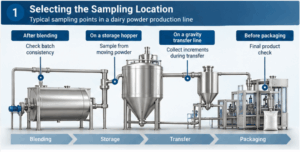
Selecting the Sampling Location
The sampling location determines which part of the dairy powder process the collected material represents. A convenient installation point does not necessarily provide the most relevant sample for laboratory analysis.
For dairy powder sampling, the selected location should correspond to the specific process stage or quality parameter that the manufacturer wants to evaluate.
After Blending
A sampling point after blending can provide information about the powder leaving the mixer or blender.
This location may help evaluate batch consistency before the product moves to downstream processing or packaging. However, the sampler should access material from the active powder flow rather than from a stagnant area near the equipment wall.
On a Storage Hopper
A storage hopper can provide a practical location for sampling, particularly when the powder moves through the hopper during production.
However, hopper geometry and powder flow can influence the material reaching the sampling point. Preferential flow paths or stagnant areas may cause local differences within the powder bed.
The sampling strategy should therefore consider the actual discharge behaviour of the product.
On a Gravity Transfer Line
A gravity transfer line can provide access to moving powder between two process stages.
This configuration can also support the collection of several increments during product transfer rather than relying on a single sample.
Relevant installation parameters include:
- Powder Flow Direction
- Transfer-Line Geometry
- Powder Velocity
- Available Installation Space
- Sampling Valve Orientation
- Chamber Filling Behaviour
- Sample Discharge Conditions
The installation should allow reliable chamber filling without unnecessarily disturbing the main powder flow.
Before Packaging
Sampling before final packaging provides information about the product at a late stage of the manufacturing process.
Several increments collected during filling may also help evaluate variation throughout the batch discharge.
However, this location represents the material entering the packaging process. It does not necessarily identify where an earlier variation originated.
💡 Engineering Insight
The sampling point should match the purpose of the laboratory analysis. A sample can correctly represent the powder passing one location at a specific moment without necessarily representing the complete production batch.
Representative Sampling of Dairy Powders
Representative sampling depends on both the sampling equipment and the overall sampling strategy.
Differences in particle size, density and flow behaviour can cause components of a dairy powder to move differently during transfer or discharge. As a result, material from one isolated location may not always reflect the powder moving through the complete process.
Sampling from Moving Powder
Where process conditions allow, collecting samples from moving powder can provide access to material passing the sampling point at different moments during production.
This approach can support the collection of several increments throughout a transfer or batch discharge.
However, moving powder does not automatically guarantee a representative sample. The sampling location, powder flow pattern and timing of each increment remain important.
Sample Quantity and Number of Increments
The laboratory requirements should determine the required sample quantity.
A defined-volume sampling chamber provides a repeatable nominal capacity. However, the actual collected mass also depends on:
- Bulk Density
- Powder Flowability
- Chamber Filling Efficiency
- Powder Compaction
- Product Adhesion
- Complete Chamber Discharge
When the laboratory requires more material, the sampling procedure can collect several increments instead of relying on one oversized chamber.
The sampling plan should define how many increments to collect, when to collect them and whether the laboratory will analyse them individually or combine them into a composite sample.
Sampling Repeatability
Consistent operating conditions can improve comparison between successive samples.
The sampling procedure should therefore define:
- Sampling Location
- Sampling Frequency
- Sampling Sequence
- Nominal Sample Volume
- Number of Increments
- Sample-Container Connection
- Sample Identification
- Handling Before Laboratory Analysis
💡 Engineering Insight
A sampling valve controls how material enters and leaves the sampling chamber, but it cannot by itself guarantee batch representativeness. The sampling plan must also define where, when and how often the process provides samples.
Sampling Valve Design for Dairy Powders
The sampling valve should collect a controlled quantity of powder while limiting product retention and supporting the required cleaning procedure.
For dairy powder sampling, the design should account for both the physical behaviour of the powder and the hygienic requirements of the production process.
Sampling Chamber
A defined-volume chamber provides a consistent nominal sampling capacity. During operation, powder enters the chamber from the process before the sampling mechanism moves it towards the discharge position.
The actual quantity collected depends on the powder and operating conditions.
Important factors include:
- Chamber Volume
- Bulk Density
- Powder Flowability
- Chamber Filling Behaviour
- Powder Adhesion
- Compaction During Sampling
- Complete Sample Discharge
For cohesive dairy powders, increasing the chamber volume does not necessarily increase the reliability of the sample. A larger chamber can still fill inconsistently or retain material after discharge.
Product-Contact Areas
The sampling system should minimize unnecessary areas where dairy powder can accumulate.
The design should consider:
- Internal Geometry
- Product-Contact Surface Finish
- Product-Contact Materials
- Transitions Between Components
- Sampling Chamber Geometry
- Discharge Path
- Accessibility for Inspection
- Compatibility With the Cleaning Procedure
The manufacturer should define the appropriate materials, surface requirements and cleaning method according to the actual product and production process.
Manual or Automated Sampling
Operators can actuate the sampling valve manually for occasional sampling. For processes requiring multiple samples during a batch, an actuator can integrate the valve into the production sequence.
Automated sampling can support:
- Defined Sampling Intervals
- Multiple Increments During Batch Transfer
- Consistent Operating Sequences
- Reduced Manual Intervention
- Traceability of Sampling Events
However, automation alone does not improve representativeness. The sampling sequence must correspond to actual powder flow and the objectives of the sampling plan.
💡 Engineering Insight
The most appropriate sampling chamber is not necessarily the largest one. Reliable filling, complete discharge and repeatability with the actual dairy powder are more important than nominal chamber capacity.
Sample Discharge and Collection
Collecting powder inside the sampling chamber represents only part of the sampling cycle. The system must also transfer the collected material reliably into the receiving container.
This step deserves particular attention for high-value dairy powders because product remaining in the discharge path can reduce the collected quantity and contribute to carryover between successive samples.
Complete Sample Discharge
Cohesive or adhesive powders may remain on internal surfaces after the sampling chamber reaches the discharge position.
The discharge behaviour depends on:
- Powder Cohesiveness
- Product Adhesion
- Sampling Chamber Geometry
- Discharge Opening
- Valve Orientation
- Sample-Container Interface
- Environmental Conditions
Trials with the actual dairy powder can help determine whether the selected configuration provides reliable filling and complete discharge.
Sample-Container Connection
The receiving container should provide a controlled collection path from the sampling valve to the final sample.
Depending on the application, the system may use a bottle, container or closed collection arrangement.
The connection should help limit:
- Product Loss
- External Contamination
- Powder Release Into the Working Area
- Moisture Exposure
- Residues Between Successive Samples
The container and closure should also remain compatible with the intended laboratory analysis.
Protecting the Sample After Collection
Sample quality can change after the powder leaves the sampling valve. The sampling procedure should therefore define how operators close, identify, store and transport the sample.
Relevant considerations include:
- Immediate Container Closure Where Required
- Sample Identification
- Batch Traceability
- Storage Conditions
- Environmental Exposure
- Time Before Laboratory Analysis
- Consistent Handling Procedures
💡 Engineering Insight
Reliable dairy powder sampling does not end when the sampling chamber empties. The discharge connection, receiving container and subsequent handling form part of the complete sampling path and can influence the condition of the material that reaches the laboratory.
Product Retention and Cleaning
High-value dairy powders can leave residues on product-contact surfaces, particularly when the formulation shows cohesive or adhesive behaviour.
Residual material inside the sampling system can affect subsequent samples and increase the effort required during product changeover. The sampling configuration should therefore limit unnecessary retention and support the site’s cleaning procedure.
Areas Where Powder Can Accumulate
The cleaning assessment should consider the complete sampling path, including:
- Sampling Chamber
- Product-Contact Surfaces
- Internal Transitions
- Discharge Path
- Sample-Container Connection
- Areas Around Moving Components
Powder behaviour plays an important role. A configuration that clears easily with a free-flowing dairy powder may retain more material when processing a cohesive or adhesive formulation.
Cleaning Between Products
Production lines may process different dairy ingredients, formulations or product grades.
When changing products, the manufacturer should define the required cleaning procedure according to the acceptable carryover limits and characteristics of the products involved.
The cleaning strategy should consider:
- Product Retention
- Carryover Limits
- Cleaning Method
- Inspection Requirements
- Accessibility of Product-Contact Areas
- Cleaning Frequency
- Verification Procedure
Equipment design can facilitate cleaning and inspection, but the manufacturer must establish and validate the cleaning procedure for the complete installation.
Product Changeover
High-value products can make changeover efficiency particularly important because excessive cleaning losses may increase product waste.
The sampling system should therefore balance cleanability with limited internal volume and low product retention.
💡 Engineering Insight
Reducing product retention can provide two benefits in high-value dairy applications: it can support contamination control between products while also limiting the quantity of valuable powder lost during cleaning and changeover.
Engineering Considerations for Dairy Powder Sampling
The final sampling configuration should reflect the actual dairy powder, process conditions and purpose of the laboratory analysis.
A product description such as milk powder, whey powder or protein concentrate does not provide enough information by itself to define the sampler.
Information Required for Sampler Selection
Useful application data include:
- Dairy Powder Type
- Particle Size Distribution
- Bulk Density
- Flowability
- Cohesive or Adhesive Behaviour
- Moisture Sensitivity
- Process Temperature
- Process Pressure
- Required Sample Quantity
- Sampling Frequency
- Installation Geometry
- Cleaning Requirements
- Sample-Container Type
- Manual or Automated Operation
These parameters help define the chamber configuration, installation position and sample collection arrangement.
Testing Difficult Dairy Powders
When powder behaviour remains uncertain, trials with the actual product can provide useful information before finalizing the sampling configuration.
Testing can evaluate:
- Chamber Filling
- Collected Sample Quantity
- Filling Repeatability
- Complete Sample Discharge
- Powder Adhesion
- Residual Product
- Behaviour During Repeated Sampling
The results can then help determine whether changes to chamber size, valve orientation or sample discharge configuration are necessary.
Evaluating the Complete Sampling Cycle
Sampler selection should not focus only on extracting powder from the process.
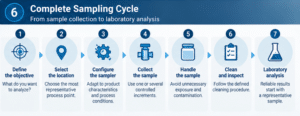
The engineering assessment should consider the complete sequence:
Process → Chamber Filling → Sample Isolation → Discharge → Collection → Container Closure → Laboratory
Each stage can influence the quantity, condition and integrity of the final sample.
💡 Engineering Insight
Testing with the actual dairy powder is particularly useful when product value is high or powder behaviour is difficult to predict. A small difference in formulation can change filling, adhesion and discharge behaviour even when two products appear similar.
Practical Recommendations
An effective high-value dairy powder sampling strategy should combine the sampling equipment, process conditions and laboratory requirements into one consistent procedure.
Before defining the final configuration, manufacturers should consider:
- Purpose of the Sample
- Dairy Powder Characteristics
- Selected Sampling Location
- Required Sample Quantity
- Number and Frequency of Increments
- Chamber Filling Behaviour
- Complete Sample Discharge
- Product Retention
- Sample-Container Connection
- Cleaning and Changeover Requirements
- Sample Identification and Traceability
- Storage and Transport Conditions
For powders with uncertain flow, adhesion or discharge behaviour, testing with the actual product can help confirm the sampling configuration before routine operation.
The manufacturer should also define how operators collect, identify, protect and transfer samples to the laboratory. This procedure helps maintain consistent sampling conditions between batches and production campaigns.
💡 Engineering Insight
The sampling valve is one element of the sampling strategy. Reliable results depend on the combination of sampling location, powder behaviour, equipment configuration, sampling frequency, sample handling and laboratory preparation.
Conclusion
High-value dairy powders can present specific sampling challenges because product value, powder behaviour, hygiene and cleaning requirements all influence the sampling process.
A suitable dairy powder sampling system should collect a controlled quantity of material from a relevant process location while limiting unnecessary product loss and retention.
For cohesive or adhesive dairy powders, particular attention should focus on chamber filling and complete sample discharge. The sampling configuration should also support the required cleaning procedure and provide a controlled path into the receiving container.
When powder behaviour remains uncertain, trials with the actual product can help determine the appropriate chamber size, valve orientation and collection arrangement.
Ultimately, representative sampling depends on the complete sampling strategy rather than on the sampling valve alone.
Discuss Your Dairy Powder Sampling Application
Milk powders, whey-based ingredients, protein concentrates and specialized dairy powders can behave differently during process sampling.
Contact our team to discuss your dairy powder, process conditions, required sample quantity and cleaning requirements, and identify an appropriate sampling configuration for your application.