 From Clean Sampling to Reliable Battery Performance
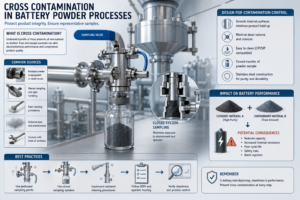
Cross contamination is one of the most critical challenges in lithium-ion battery manufacturing.
Even microscopic traces of foreign material may alter battery chemistry, affect electrochemical performance or lead to costly batch investigations. As battery manufacturers increasingly produce multiple chemistries on the same production site, preventing contamination has become a key quality objective.
Reliable powder sampling plays an essential role in maintaining product purity throughout the manufacturing process.
Why Cross Contamination Matters
Battery materials are extremely sensitive to contamination.
Even trace amounts of foreign particles may influence laboratory analysis, reduce product consistency or require unnecessary batch rejection.
Contamination control is therefore essential throughout the entire production process, including powder sampling.
Typical applications include:
- Incoming raw material inspection
- Reactor sampling
- Mixer sampling
- Spray dryer sampling
- Intermediate process control
- Final quality control
- Battery recycling
Each sample must accurately represent the product while remaining completely free from external contamination.
Common Sources of Contamination
Several factors may introduce contamination during powder sampling.
Residual Powder in Dead Zones
Some entry-level sampling devices may retain residual powder after each sampling cycle due to larger dead zones. Residual material can contaminate subsequent batches, particularly when switching between battery chemistries.
Manual Sampling Procedures
Open manual sampling exposes powders to the surrounding environment and increases the risk of contamination.
Poorly Cleaned Equipment
Incomplete cleaning between production campaigns may leave traces of previous materials inside process equipment or sampling devices.
Airborne Dust
Fine battery powders may become airborne during sampling and settle on adjacent equipment or containers.
Contact with Tools
Scoops, spatulas and sampling containers may introduce contaminants if not properly cleaned or dedicated to a single product.
Designing for Clean Powder Sampling
An effective powder sampling system should minimize every possible source of contamination.
Key design features include:
- Smooth internal surfaces
- Minimal dead volume
- Closed powder transfer
- Easy cleaning
- Stainless steel construction
- Repeatable sampling
- Reliable sealing
- Low maintenance
The design of the sampling valve directly influences both product purity and process reliability.
Operator Protection
Many battery materials contain hazardous compounds such as nickel or cobalt that require careful handling.
Closed powder sampling systems help:
- Reduce operator exposure
- Limit dust emissions
- Improve workplace safety
- Increase sampling repeatability
- Support contamination control strategies
Operator protection and product protection should always be considered together.
Choosing the Right Sampling Valve
Not every sampling valve is suitable for contamination-sensitive battery powders.
The ideal powder sampling valve should provide:
- Representative sampling
- Closed sampling
- Minimal dead zones
- Easy cleaning
- Excellent sealing
- Robust stainless steel construction
- Compatibility with automated production lines
These characteristics help manufacturers maintain both product quality and process efficiency.
FAMAT Sampling Solutions
For more than 50 years, FAMAT Sampling has specialized in the design and manufacture of powder sampling valves for demanding pharmaceutical, chemical and battery material applications.
Our sampling solutions help manufacturers:
- Reduce contamination risks
- Protect operators
- Improve sampling repeatability
- Simplify cleaning procedures
- Maintain product integrity
Reliable sampling contributes directly to consistent battery quality and improved manufacturing efficiency.
Looking for a reliable powder sampling valve for battery materials?
Discover how FAMAT helps manufacturers minimize contamination risks while improving sample integrity and operator safety.
Frequently Asked Questions
What is cross contamination in battery powder manufacturing?
Cross contamination occurs when traces of one material unintentionally mix with another, potentially affecting battery chemistry, product quality and process reliability.
How can cross contamination be prevented during powder sampling?
Contamination can be minimized by using enclosed sampling systems, dead-zone-free designs, effective cleaning procedures and dedicated sampling equipment.
Why are dead zones a contamination risk?
Dead zones may retain residual powder after sampling. During subsequent production batches, these residues can contaminate new materials.
Why is closed powder sampling preferred?
Closed sampling reduces operator exposure, limits airborne dust and minimizes the risk of external contamination.
Which battery materials require contamination control?
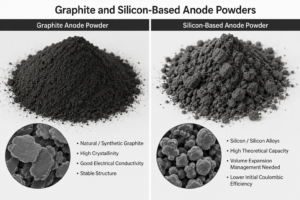
Graphite, NMC, LFP, NCA, LMFP, lithium compounds, silicon-based materials and recycled battery powders all require strict contamination control during sampling.
What is a powder sampling valve?
A powder sampling valve is a device installed on reactors, mixers, dryers or hoppers to collect representative powder samples while minimizing contamination and operator exposure.