Introduction
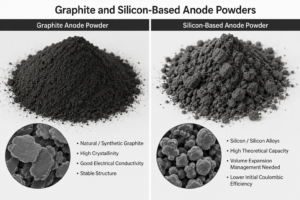
Silicon anode powder sampling presents specific challenges when graphite and silicon-based materials are processed as fine powders. The anode is a key component of every lithium-ion battery. While cathode materials may vary between LFP, NMC and other chemistries, graphite remains the predominant anode material used in commercial electric vehicle batteries.
Manufacturers typically choose between natural and synthetic graphite depending on what they need in terms of performance, cost, and how the material fits into their production line. Silicon-based materials are also starting to make their way in, usually blended with graphite, because silicon can significantly boost the amount of lithium the anode can hold.
That said, working with graphite and silicon-based powders isn’t always straightforward. Depending on factors like particle size, particle shape, surface treatment, and overall composition, these materials can have a low bulk density, poor flow characteristics, or a tendency to clump together.

Powder Behaviour During Sampling
Fine anode powders in particular can compact, bridge, or stick to internal surfaces. Electrostatic charge can also play a role in how the powder moves and where it ends up. All of this means that a sampling chamber with a fixed nominal volume might not fill or empty as consistently as you’d expect.
This makes anode powder sampling a different kind of problem compared to LFP or NMC cathode powders. With anode materials, the real concern isn’t just protecting the powder from atmospheric exposure—it’s making sure the powder can actually get into the sampling chamber in the first place, that it stays representative of the process stream, and that it fully discharges into the receiving container without leaving anything behind.
This technical application note covers representative sampling of graphite and silicon-based anode powders, with a focus on the challenges posed by low bulk density, poor flowability, chamber filling behavior, and powder retention.
The discussion draws partly on an anonymized industrial inquiry involving a fine anode material with a particle size of roughly 5 to 8 microns, a bulk density around 0.4 g/ml, and an operating temperature close to 70 °C. It’s worth noting that these figures come from that specific case and shouldn’t be treated as typical values for all graphite or silicon-based anode powders.
Sources: International Energy Agency, Global EV Outlook 2026, May 2026 and Cao et al., Nature Communications, 2024
The Application
This application concerns the collection of a representative sample from a fine anode material during transfer from process equipment to a downstream container or packaging system.
The material characteristics provided for the enquiry were:
- Particle size: approximately 5 to 8 µm
- Bulk density: approximately 0.4 g/ml
- Process temperature: approximately 70 °C
- Flow behaviour: poor or non-free-flowing
The sampling point was intended to provide material for quality-control analysis without requiring the operator to open the process or manually collect powder from a container.
The laboratory sample may be used to evaluate:
- Particle size distribution
- Moisture content
- Chemical composition
- Graphite or silicon content
- Bulk or tapped density
- Impurities
- Particle morphology
- Batch homogeneity
The Main Engineering Question
The principal question is whether the powder can enter a volumetric sampling chamber and discharge from it consistently.
A chamber may have a defined internal volume, but the actual sample mass depends on how the powder fills that volume. A cohesive material may form a bridge above the opening, remain attached to the chamber walls or become compacted during piston movement.
For a powder with a bulk density of approximately 0.4 g/ml, a nominal chamber volume of 10 ml would theoretically contain about 4 g of material:
This calculation assumes complete and uniform filling. It does not account for voids, bridging, compaction or retained powder.
Proposed Sampling Position
The sampling valve may be considered for installation:
- Below a blender
- Below an industrial dryer
- On the lower section of a hopper
- On a gravity transfer line
- Before final packaging
The preferred position is one where the powder is moving and can reach the sampling chamber. However, the equipment geometry and actual flow pattern must be reviewed before selecting the final location.
This application note does not claim that the proposed chamber has already been validated with this material. Testing with the actual powder remains necessary.
💡Engineering Insight
When you’re dealing with a cohesive anode powder, the chamber’s nominal volume and the theoretical sample mass are really just a starting point. What actually determines sampling reliability is how the material behaves in practice, whether it can flow into the chamber and back out again under real process conditions.
Silicon Anode Powder Sampling Challenges
Fine graphite and silicon-based powders may not flow freely into a sampling chamber. Their behaviour depends on particle size, morphology, moisture, surface treatment and process conditions.
The main difficulties include:
- Bridging above the chamber opening
- Incomplete or inconsistent filling
- Powder adhesion to internal surfaces
- Compaction during piston movement
- Incomplete discharge into the sample container
- Electrostatic attraction and dust formation
With a particle size of approximately 5 to 8 µm and a bulk density of about 0.4 g/ml, the material considered in this application may be particularly sensitive to cohesion and retention.
A larger chamber would not necessarily solve the problem. It could increase the quantity of retained or compacted powder if the material does not enter and discharge correctly.
💡Engineering Insight
For poorly flowing anode powders, reliable chamber filling is more important than nominal chamber size.
Improving Chamber Filling and Discharge
The sampling point should be located where the powder is moving and can enter the chamber naturally. Installation on a stagnant area of a hopper may result in incomplete filling.
Several measures may improve sampling reliability:
- Selecting a chamber volume suited to the required sample mass
- Installing the valve at a slight angle to support gravity discharge
- Avoiding long or restrictive discharge connections
- Using an appropriate surface finish
- Collecting several smaller increments instead of one large sample
- Applying vibration or gas assistance only when permitted and validated
Any gas used to assist discharge must be compatible with the material and must not alter the sample or disperse fine powder into the working area.
💡Engineering Insight
The most effective configuration is the one that allows the powder to enter and leave the chamber consistently without changing the sample.
Engineering Considerations for Silicon Anode Powder Sampling
For this application, a DN50 FAMAT sampling valve may be considered because its larger product opening provides more space for a cohesive powder to enter the chamber.
The proposed configuration should include:
- A sampling chamber selected according to the required sample mass
- Installation where the powder is actively moving
- A short and direct discharge path
- A slightly inclined position where gravity discharge needs assistance
- A closed receiving container to control dust and contamination
For installation on a vertical gravity chute, an intrusive sampler that enters the powder stream may also be evaluated.
The final valve type and chamber size must be confirmed after reviewing the equipment geometry and testing the actual anode powder.
💡Engineering Insight
For a low-density, poorly flowing powder, the installation position may have more influence on sampling reliability than the valve size alone.
Testing and Validation
Testing with the actual anode powder is recommended before finalising the sampling configuration.
The test should verify:
- Complete chamber filling
- Consistency of the collected mass
- Complete discharge into the container
- Powder retention after operation
- Repeatability over several sampling cycles
- Behaviour at the expected process temperature
- Cleaning between samples or batches
The collected mass should be compared across repeated cycles. Any variation caused by bridging, compaction or incomplete discharge should be documented.
Testing should also confirm that the sampling operation does not alter the properties required for laboratory analysis.
💡Engineering Insight
Successful valve operation does not automatically mean successful sampling. Validation must confirm that the collected samples are consistent and suitable for analysis.
Conclusion
Representative sampling of fine graphite and silicon-based anode powders depends on the material’s ability to enter and leave the sampling chamber consistently.
For low-density or cohesive powders, the main considerations are:
- Particle size and flowability
- Sampling location
- Chamber filling and discharge
- Installation orientation
- Powder retention
- Required sample mass
- Repeatability and cleaning
A larger chamber does not necessarily provide a better sample. The complete configuration should be tested with the actual powder under representative process conditions.
Discuss Your Anode Powder Sampling Application
FAMAT Sampling can review the powder characteristics, process geometry, sample quantity and operating conditions to define a suitable testing and sampling configuration.
Contact FAMAT Sampling to discuss your graphite or silicon-based anode powder application.
Learn more white paper