Highly Potent Active Pharmaceutical Ingredients, commonly called HPAPIs, are pharmaceutical compounds that can produce pharmacological or toxicological effects at very low exposure levels. They are used in a range of therapies, including oncology, hormonal treatments and other targeted medicines.

However, HPAPI does not represent one universal regulatory category. The required containment level depends on the specific substance, its toxicological assessment, the manufacturing process and the site risk assessment.
Sampling is a critical operation because it transfers material from closed process equipment to a laboratory container. During this transfer, the system must protect the operator from powder exposure while preserving the sample and limiting the risk of cross-contamination.
A high-containment sampling solution should therefore provide a controlled path from the process to the receiving container. The design must be assessed together with the material properties, required sample quantity, operating procedure, cleaning strategy and containment target.
FAMAT’s 125TC/OEL sampling system combines a volumetric sampling valve with an active and passive split butterfly valve. The passive half-valve remains connected to the sample bottle and can be removed in its closed position. This arrangement is designed to allow sample recovery under contained conditions.
According to FAMAT’s published product information, the 125TC/OEL system is specified for an OEL range of 1 to 10 µg/m³ without aspiration and below 1 µg/m³ with aspiration. The applicable containment performance must nevertheless be confirmed for the complete installation and operating procedure.
This article explains the risks associated with HPAPI sampling, the role of OEL and OEB targets, and the engineering considerations for integrating a high-containment sampling system into pharmaceutical powder processes.
Sources: FAMAT 125TC/OEL High Containment Sampling System and European Medicines Agency, Guideline on Health-Based Exposure Limits.
Why Sampling Is a Critical HPAPI Operation
In HPAPI manufacturing, sampling is not a minor manual task. It is a controlled transfer operation between process equipment and the laboratory.
The process may remain closed during blending, drying or storage. However, a sampling operation can introduce exposure points when the system fills the sampling chamber, discharges the material, connects the receiving container or removes the collected sample.
The principal risks are:
- Operator Exposure to Airborne Powder
- Uncontrolled Release During Container Connection or Removal
- Cross-Contamination Between Products or Batches
- Loss of Sample Integrity
- Product Retention Inside the Sampling System
- Inadequate Cleaning or Inspection
A manual scoop sample from an opened vessel creates a very different exposure scenario from a sample recovered through a closed connection. The appropriate method depends on the substance-specific exposure target, powder behaviour, required sample mass and operating frequency.
For HPAPIs, the sampling system should be assessed as part of the complete containment strategy. This assessment must include the valve, receiving container, connection method, operating sequence, cleaning procedure and laboratory transfer.
💡Engineering Insight
The containment level of a sampling valve alone does not define the containment performance of the complete sampling operation.
The European Medicines Agency identifies uncontrolled release from active substances, equipment residues and operator clothing as potential sources of cross-contamination in shared manufacturing facilities. A science- and risk-based assessment is therefore necessary for every substance and process.
Source: European Medicines Agency, Guideline on Health-Based Exposure Limits.
OEL and OEB: Defining the Required Containment Target
An Occupational Exposure Limit, or OEL, defines an airborne concentration target for a specific substance over a defined period of time. It is used to help protect workers from harmful exposure.
The OEL for an HPAPI must be determined from substance-specific pharmacological and toxicological information. It cannot be established from the description “HPAPI” alone.
An Occupational Exposure Band, or OEB, groups substances with comparable toxicological potency into exposure ranges. However, OEB systems are not fully harmonised. The band definitions, numbering and associated containment expectations may differ between companies, consultants and occupational-health frameworks.
Therefore, a statement such as “OEB5 containment” is meaningful only when the applicable banding system and exposure range have been defined by the site.
OEL, OEB and Containment Performance
These three terms describe different elements of the same risk-management process:
| Term | Purpose |
|---|---|
| OEL | Defines the exposure target for a specific substance |
| OEB | Groups substances into a potency or exposure band |
| Containment Performance | Demonstrates how the complete equipment and operating procedure control exposure |
The engineering objective is not simply to select a device labelled for a particular OEB. The objective is to define a sampling arrangement that supports the required OEL under actual operating conditions.
This assessment should consider:
- The Substance-Specific OEL or Internal Exposure Target
- Powder Dispersion Behaviour
- Sample Quantity and Sampling Frequency
- Container Connection and Removal
- Local Extraction or Aspiration
- Cleaning and Maintenance Activities
- The Measurement Method Used to Verify Exposure
FAMAT’s published data for the 125TC/OEL system indicates an OEL range of 1 to 10 µg/m³ without aspiration and below 1 µg/m³ with aspiration. These values describe the product configuration published by FAMAT. The site must confirm the applicable containment performance for the complete installed system and validated operating sequence.
💡Engineering Insight
An OEB identifies the potential hazard. An OEL defines the exposure target. Containment testing verifies whether the process can achieve that target.
Sources: NIOSH, Occupational Exposure Banding, updated 3 March 2026, UK Health and Safety Executive, Workplace Exposure Limits and FAMAT 125TC/OEL High Containment Sampling System.
Selecting the Right FAMAT Containment Solution
HPAPI sampling does not require the same containment arrangement for every process. The appropriate solution depends on the substance-specific exposure target, sampling frequency, required sample quantity, bottle handling method and available installation space.
FAMAT offers several containment solutions that can be combined with its powder sampling valves.
| FAMAT Solution | Typical Recovery Method | Containment Level Indicated by FAMAT | Main Application |
|---|---|---|---|
| REVOBOX® Sampling Cabinet | Closed Bottle Handling Inside a Cabinet | OEB 2 | Closed Sampling with Improved Operator Protection |
| Flexible Containment Chamber | Bottle Handling Through Integrated Gloves | OEB 4, <10 µg/m³ | Contained Sampling Where a Flexible Isolator Is Appropriate |
| 125TC/OEL with Split Butterfly Valve | Active and Passive SBV Connection | OEB 5 | High-Containment Bottle Recovery |
| Continuous Liner System | Multiple Samples or Bags Collected in a Continuous Liner | OEB 5, <1 µg/m³ | High-Containment Sampling and Repeated Contained Transfer |
The stated containment level must always be confirmed for the complete installed system and validated operating procedure.
REVOBOX® Sampling Cabinet for OEB 2 Applications
The REVOBOX® is a closed sampling cabinet designed for FAMAT DN50 sampling valves and available as an option for DN25 valves.
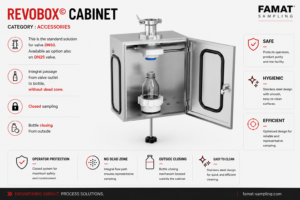
It provides an integral passage from the valve outlet to the bottle, with bottle closure performed from outside the cabinet. This arrangement supports closed sample recovery while providing a practical solution for applications requiring an OEB 2 containment level.
The REVOBOX® may be considered when the process requires:
- Closed Sampling
- Controlled Bottle Handling
- Reduced Powder Release During Sample Recovery
- A Compact Stainless-Steel Cabinet
- A 500 mL Bottle Configuration
Flexible Containment Chamber for OEB 4 Applications
The Flexible Containment Chamber is a soft-wall isolator that connects directly to the sampling valve. Operators manipulate the bottle through integrated glove ports while maintaining a contained working environment.
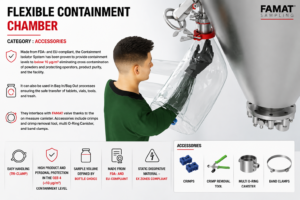
FAMAT indicates OEB 4 containment performance below 10 µg/m³ under validated operating conditions.
This solution may be appropriate when:
- The Required Containment Level Exceeds a Closed Cabinet Solution
- Operators Need Direct Access to the Bottle
- A Rigid Isolator Is Not Required
- Installation Flexibility Is Important
- The Process Requires a Bag-In/Bag-Out Procedure
125TC/OEL Split Butterfly Valve System for OEB 4/5 Applications
The 125TC/OEL combines a volumetric sampling valve with a split butterfly valve interface. The system uses an active module on the valve outlet and a passive module on the sampling bottle.
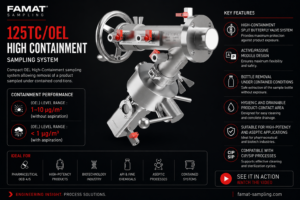
After sample recovery, the operator removes the passive module in its closed position. This configuration supports high-containment applications by keeping the process, valve and receiving bottle linked through a controlled interface during sample recovery.
FAMAT publishes an OEL range of 1 to 10 µg/m³ without aspiration and below 1 µg/m³ with aspiration for this system.
Continuous Liner System for OEB 5 Applications
The Continuous Liner System supports the contained recovery of multiple samples or bags without opening the containment path between each collection.
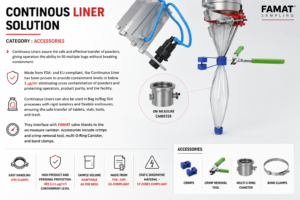
A dedicated canister connects the Continuous Liner System to FAMAT valves and supports Bag-In/Bag-Out processes. FAMAT indicates containment below 1 µg/m³ for this OEB 5 solution. FAMAT indicates containment below 1 µg/m³ for this OEB 5 solution.
Choose this system when the process requires:
- Multiple Sample Collections
- Flexible Sample Volume
- Repeated Contained Transfer
- Reduced Handling Between Samples
- A Continuous Containment Barrier
💡Engineering Insight
The appropriate solution is determined by the complete recovery operation. The required containment level, sample quantity, sampling frequency and operator actions must be assessed together.
Sources: FAMAT REVOBOX® Cabinet, FAMAT Flexible Containment Chamber, FAMAT 125TC/OEL High Containment Sampling System and FAMAT Continuous Liner Solution.
Integrating High-Containment Sampling into the Process
Select a sampling location that represents the material the laboratory result is intended to describe. A convenient installation point is not always the correct sampling point.
Install the sampling system at one of the following locations in an HPAPI process:
- Below a Dryer
- On a Blender or Mixer Outlet
- On an Intermediate Storage Hopper
- Along a Gravity Transfer Line
- Before Final Container Filling
- On Equipment Used for Pilot or Development Batches
The final position depends on the process flow, powder behaviour, batch definition and analytical objective.
Sampling from Closed Equipment
A direct connection between the process equipment and the sampling valve reduces the need for open handling. The selected configuration should maintain a controlled path from the product stream to the sample receiver.
The engineering review should confirm:
- The Powder Can Reach the Sampling Chamber
- The Sampling Point Does Not Create a Stagnant Zone
- The Chamber Can Fill and Discharge Reliably
- The Receiving System Matches the Required Containment Level
- The Operator Can Perform the Sequence Safely
- Cleaning and Inspection Remain Possible
Manual or Automated Sampling
Manual operation may be appropriate for occasional sampling when an operator performs a defined procedure.
Automated actuation may be appropriate when the process requires:
- Repeated Sampling at Defined Intervals
- Sampling During Batch Transfer
- Multiple Increments for One Composite Sample
- Reduced Operator Interaction Near the Process
- Integration with the Plant Control System
Automation can standardise the valve cycle and sampling frequency. However, the system must still demonstrate reliable chamber filling, discharge and containment under the actual process conditions.
Selecting the Recovery Interface
The receiving interface must match the required containment target and operator procedure.
For example:
| Application Requirement | Recovery Interface to Evaluate |
|---|---|
| Closed Sampling with Standard Bottle Handling | REVOBOX® Cabinet |
| OEB 4 Contained Bottle Handling | Flexible Containment Chamber |
| OEB 5 Bottle Recovery | 125TC/OEL Split Butterfly Valve System |
| OEB 5 Repeated Sampling or Flexible Bag Collection | Continuous Liner System |
The final selection should include a review of sample transport to the laboratory. A well-contained valve connection can lose its value if the sample bottle or liner is opened, incorrectly sealed or inadequately identified after recovery.
💡Engineering Insight
Process integration is complete only when the sample reaches the laboratory in a condition that remains safe, identifiable and suitable for analysis.
Testing, Validation and Ongoing Performance
A high-containment sampling system must demonstrate performance under the actual operating conditions. Product design alone does not establish that the complete installation meets the required containment target.
The qualification strategy should assess the valve, recovery interface, operator procedure, cleaning method and sample transfer to the laboratory.
Containment Assessment
The containment assessment should reflect the specific HPAPI, exposure target and operating sequence.
The test plan may include:
- Bottle or Liner Connection
- Valve Operation
- Sample Discharge
- Bottle, Passive Module or Liner Removal
- Cleaning and Maintenance Activities
- Abnormal or Recovery Scenarios
The site should define the measurement method, sampling locations, duration, operating parameters and acceptance criteria before testing begins.
Functional Performance
Containment alone is not sufficient. The system must also collect a suitable sample.
Functional testing should confirm:
- Chamber Filling
- Sample Mass Repeatability
- Complete Sample Discharge
- Powder Retention After Sampling
- Integrity of the Receiving Interface
- Correct Operation Over Repeated Cycles
- Suitability of the Collected Sample for Laboratory Analysis
Cleaning and Carryover Control
The cleaning strategy must reflect the health-based exposure limit, material characteristics and acceptable carryover between products or batches.
The engineering review should identify potential retention areas, including:
- The Sampling Chamber
- The Product-Contact Piston Area
- The Discharge Connection
- The Bottle or Liner Interface
- The Split Butterfly Valve Surfaces
- Flexible Containment Components
Cleaning effectiveness must be demonstrated through the site’s approved procedure. A sampling system may support cleaning, but the complete installation requires validation by the user.
Documentation and Maintenance
The operating file should define:
- The Approved Sampling Sequence
- Required Personal Protective Equipment
- Sample Identification and Transport Procedure
- Cleaning Instructions
- Inspection Frequency
- Maintenance Requirements
- Acceptance Criteria for Wear or Damage
- Requalification Requirements After Changes
Changes to the HPAPI, sample receiver, containment interface, operating procedure or process conditions may require reassessment.
💡Engineering Insight
The relevant question is not whether a component is high-containment. The relevant question is whether the complete sampling operation consistently meets the defined exposure and product-quality requirements.
Source: European Medicines Agency, Guideline on Health-Based Exposure Limits.
How to Specify an HPAPI Sampling System
A clear specification prevents the containment solution from being selected solely on the basis of a nominal OEB level.
Before selecting the configuration, define the following points:
| Question | Why It Matters |
|---|---|
| What Is the Substance-Specific OEL? | Defines the required exposure target |
| Which OEB System Does the Site Use? | Prevents confusion between different banding schemes |
| What Must the Sample Represent? | Defines the sampling point and increment strategy |
| What Sample Quantity Is Required? | Determines chamber volume and receiving system |
| How Often Will Sampling Occur? | Influences manual, automated or continuous-liner selection |
| How Must the Operator Handle the Sample? | Determines the suitable containment interface |
| What Is the Cleaning and Carryover Requirement? | Defines inspection and cleaning strategy |
| How Will the Sample Reach the Laboratory? | Ensures containment continues after recovery |
The system selection should then follow the required recovery method:
- Choose REVOBOX® for Closed Sampling and OEB 2 Applications
- Choose a Flexible Containment Chamber for OEB 4 Contained Bottle Handling
- Choose the 125TC/OEL Split Butterfly Valve System for OEB 5 Bottle Recovery
- Choose a Continuous Liner System for OEB 5 Repeated Sampling or Flexible Bag Collection
These categories provide an initial engineering guide. FAMAT should review the final configuration with the user’s process data, sample requirements and containment target.
💡Engineering Insight
The best containment solution is not the most complex one. It is the solution that demonstrably meets the required exposure target while allowing reliable sampling and practical operation.
Conclusion
HPAPI sampling requires more than a standard sampling valve. The complete process must control powder exposure from the process connection through sample recovery, container removal and transfer to the laboratory.
FAMAT provides several containment solutions for different sampling requirements:
- REVOBOX® for Closed Sampling and OEB 2 Applications
- Flexible Containment Chamber for OEB 4 Bottle Handling
- 125TC/OEL Split Butterfly Valve System for OEB 5 Bottle Recovery
- Continuous Liner System for OEB 5 Repeated Sampling and Flexible Bag Collection
The required configuration depends on the substance-specific OEL, the site’s OEB classification system, powder behaviour, sample quantity, sampling frequency and operator procedure.
Before routine use, the complete installed system should be tested and qualified under representative conditions. This approach supports operator protection, sample integrity, contamination control and practical operation.
Discuss Your HPAPI Sampling Application
FAMAT Sampling can review your application according to:
- HPAPI Characteristics and Exposure Target
- Required Sample Quantity
- Process Equipment and Sampling Location
- OEB and OEL Requirements
- Bottle, Split Butterfly Valve or Liner Interface
- Manual or Automated Sampling
- Cleaning, Maintenance and Validation Requirements
Contact FAMAT Sampling to discuss your HPAPI sampling application.
Related High-Containment Solutions
- 125TC/OEL High Containment Sampling System
- Flexible Containment Chamber
- Continuous Liner Solution
- REVOBOX® Sampling Cabinet