Introduction
When making lithium-ion batteries, manufacturers pick different cathode materials based on how well the battery needs to perform, how much it costs, how safe it is, and where the materials come from. Electric vehicle manufacturers currently use two main cathode families: lithium iron phosphate (LFP) and nickel-based materials, mainly nickel manganese cobalt oxide (NMC) and nickel cobalt aluminium oxide (NCA).
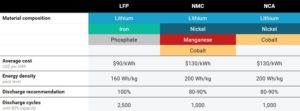
Manufacturers generally select NMC and NCA cathodes when high energy density is a priority. Increasing the nickel content can increase the amount of energy stored, but it can also make the cathode material more reactive and more sensitive to its handling and storage conditions.
Common NMC compositions include NMC 111, NMC 532, NMC 622 and NMC 811. These numbers indicate the relative proportions of nickel, manganese and cobalt. NMC 811, for example, contains a higher proportion of nickel than NMC 622. However, the exact properties of a cathode powder also depend on its manufacturing process, particle morphology, surface treatment and storage conditions.
Historically, manufacturers in Europe and North America have used nickel-based cathodes more widely than LFP, particularly for electric vehicles requiring longer driving ranges. LFP has a stronger position in China, although its use is also expanding in other regions. Battery chemistry choices continue to evolve according to vehicle design, cost and supply-chain strategy.
Sampling Considerations for NMC Cathode Powders
For NMC and nickel-rich cathode powders, exposure to air and moisture can modify the material surface and affect subsequent electrode processing. The level of sensitivity is not identical for every NMC grade. Manufacturers should therefore assess this sensitivity according to the specific composition and the supplier’s material requirements.
Opening the process or manually transferring powder into an unsuitable container can create a point of exposure during sampling.
A representative sampling system must therefore do more than collect the required quantity of powder. It should preserve the condition of the material, limit uncontrolled atmospheric exposure and reduce contamination risks between the process and the laboratory.
This application case study examines direct process sampling of NMC and nickel-rich cathode powders using closed process equipment to maintain sample integrity and protect the operator.
Sources : Yu et al., Nature Communications, 15 July 2025, International Energy Agency, regional battery chemistry data, updated 8 April 2025, Journal of Electrochemical Energy Conversion and Storage, 2021
The Application
Manufacturers produce NMC cathode active material through several processing stages that may include precursor preparation, lithiation, calcination, milling, classification, coating, blending and final packaging. The exact sequence depends on the cathode composition and the manufacturer’s production method.
In this application scenario, the process transfers the finished NMC or nickel-rich cathode powder from a final blender or storage vessel towards the packaging system. The quality-control team collects samples before releasing the batch or supplying it to the electrode manufacturing process.
The laboratory analyses may include:
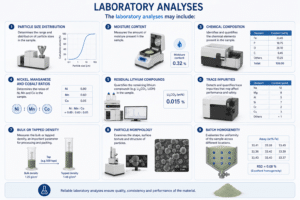
Because the powder may be sensitive to atmospheric exposure, the sampling operation must preserve the condition of the material between the process and the laboratory.
Opening a vessel or manually transferring the powder can expose the sample to ambient moisture and carbon dioxide. It can also introduce contamination from sampling tools, containers or the surrounding environment.
For this application, the process equipment integrates the proposed sampling system directly into the closed powder-handling line. Depending on the production layout, the sampling point may be located:
- Below the final blender
- On an intermediate storage hopper
- Along a gravity transfer line
- Before the final packaging station
The sample is collected in a defined-volume chamber and discharged into a suitable closed container. Where the material specification requires it, the sampling configuration can also provide sample recovery under a controlled or inert atmosphere.
The final sampling configuration must be based on the actual NMC grade, process conditions, required analyses and permitted level of atmospheric exposure. The material’s commercial designation alone should not determine the sampling configuration.
💡Engineering Insight
“NMC powder” does not describe one uniform material. Composition, nickel content, particle structure and surface treatment can all influence how the powder must be sampled and protected.
The Sampling Challenge
Representative sampling of NMC and nickel-rich cathode powder requires control of both the collected material and the surrounding sampling environment. Several factors might influence sample integrity:
Moisture and Air Exposure
NMC powders can react with components of the surrounding atmosphere. The degree of sensitivity varies according to nickel content, particle structure, surface treatment and storage conditions.
Opening the process during sampling may expose the powder to humidity and carbon dioxide. This exposure can modify the surface condition of the sample before it reaches the laboratory.
The material specification should therefore define the permitted exposure time and atmospheric conditions.
Differences Between NMC Grades
NMC 111, NMC 532, NMC 622 and NMC 811 do not have identical characteristics. Increasing the nickel content changes the chemistry and can increase the material’s sensitivity to handling conditions.
Manufacturers should review the product specification before applying the sampling procedure from one NMC grade to another.
Particle Segregation
Differences in particle size, density or morphology may cause segregation during blending, transfer, hopper discharge or packaging.
A sample collected from a stagnant zone or only one part of the powder stream may not accurately represent the complete batch.
Metallic and Cross-Contamination
Trace contamination can be important when evaluating cathode active materials. Potential sources include:
- Unsuitable product-contact materials
- Wear particles
- Residues from previous batches
- Sampling tools
- Open containers
- The surrounding production environment
The materials and surface condition of the sampling equipment must be compatible with the producer’s impurity limits.
Powder Retention
Fine powder can remain inside the sampling chamber, around seals or within the sample discharge path. Residual material may affect the next sample or create carryover between different NMC grades.
The equipment must therefore allow appropriate inspection and cleaning.
Operator Exposure
Manual sampling can release fine cathode powder into the working environment. A closed sampling and container connection can reduce direct handling, but the required containment level must be determined through the site’s risk assessment.
💡Engineering Insight
For nickel-rich cathode materials, representative sampling and sample protection are closely connected. A representative sample can lose its value if its condition changes before laboratory analysis.
Controlled-Atmosphere Sampling Concept
When NMC powder is stored or transferred under a controlled atmosphere, the sampling operation should preserve those conditions as far as required by the material specification.
Installing a sampling valve on closed process equipment reduces open handling. However, a closed system is not necessarily free from ambient air. Air may remain inside:
- The sampling chamber
- The discharge outlet
- The connection between the valve and the container
- The empty sample container
These volumes must be considered when defining the sampling procedure.
Standard Closed Sampling
A standard closed arrangement may be sufficient when brief atmospheric exposure is acceptable.
The sample is collected directly from the process and discharged into a connected container, limiting powder release and manual handling. The container is then closed and transferred to the laboratory.
Inert-Gas-Assisted Sampling
When stricter atmospheric control is required, the sampling container, discharge connection or receiving container may need to be purged with a compatible inert gas before the sample is collected.
A possible operating sequence is:
- connect the prepared sample container
- purge the relevant internal volumes
- isolate or stop the purge according to the validated procedure
- fill the sampling chamber from the process
- move the chamber to the discharge position
- release the sample into the container
- close or isolate the container before removal
The exact sequence depends on the valve configuration, process pressure and required level of atmospheric protection.
Defining the Required Protection
The cathode-material manufacturer should specify:
- Maximum permitted moisture exposure
- Acceptable oxygen and carbon dioxide levels
- Permitted exposure duration
- Required inert gas
- Sample-container preparation
- Sealing and transport conditions
Without these values, it is not possible to determine whether standard closed sampling is sufficient or whether inert-gas-assisted sampling is necessary.
💡Engineering Insight
The appropriate sampling atmosphere must be based on the material specification. Adding an inert-gas purge without defined acceptance criteria does not by itself prove that the sample has been protected.
Purging the Sampling Chamber and Container
If you need to keep the powder from being exposed to the atmosphere, purging can help. It clears out the ambient air sitting in the sampling path before the powder even reaches the chamber or receiving container.
Just keep in mind : the purge system has to work around the entire sampling assembly, not just the valve by itself.
Areas to Be Considered
The volumes potentially requiring purging include:
- the sampling chamber
- the discharge cavity
- the connection between the valve and container
- the empty receiving container
- any flexible hose or adapter used for sample recovery
If one of these volumes remains open to the surrounding atmosphere, the expected protection may not be achieved.
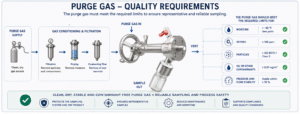
Purge Gas
The gas must be compatible with the powder, process and laboratory analysis. Nitrogen or argon may be considered, but the appropriate gas must be selected and approved by the material manufacturer.
The purge gas should meet the required limits for:
- moisture
- oxygen
- particles
- oil or other contaminants
- pressure and flow stability
Purging Sequence
A possible sequence consists of connecting the sample container, purging the enclosed volume and then operating the sampling valve.
The required purge duration or number of volume exchanges cannot be defined without knowing:
- the internal volume of the system
- gas flow rate
- connection geometry
- initial atmospheric conditions
- permitted residual moisture and oxygen levels
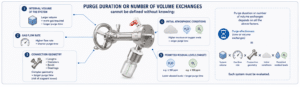
These parameters should be established during qualification.
Pressure Management
The purge must not create an uncontrolled pressure increase inside the sample container or discharge connection.
The design may require a controlled gas outlet, pressure limitation or verified vent path. Any discharged gas and entrained powder must be handled according to the site’s safety and containment requirements.
Sealing the Sample
After collection, the container should be isolated from the sampling system without exposing its contents to ambient air.
Depending on the application, this may involve:
- a closable bottle
- a sealed sampling receiver
- an isolation valve
- a prepared container transferred to a glovebox
- another validated closed-transfer arrangement
💡Engineering Insight
Purging is effective only when gas flow, internal volume, outlet path and acceptance criteria are defined. Purge time alone does not demonstrate atmospheric control.
Standard Closed Sampling vs Inert-Gas Sampling
The appropriate sampling arrangement depends on the sensitivity of the NMC powder and the purpose of the laboratory analysis.
A standard closed system may be adequate for some materials, while nickel-rich or specially treated cathode powders may require stricter atmospheric control.
| Consideration | Standard closed sampling | Inert-gas-assisted sampling |
|---|---|---|
| Process opening | Not required during normal sampling | Not required during normal sampling |
| Powder containment | Sample remains within a closed path | Sample remains within a closed and purged path |
| Ambient air in the chamber | May remain present | Reduced through a defined purge sequence |
| Sample container | Connected before sample discharge | Connected and potentially purged before discharge |
| Moisture protection | Limited by residual air and container conditions | Greater control when correctly designed and validated |
| Operating complexity | Lower | Higher |
| Gas supply | Not required | Compatible inert gas required |
| Pressure management | Generally simpler | Purge pressure and outlet path must be controlled |
| Validation requirements | Chamber filling, discharge and containment | Additional verification of purge effectiveness and residual atmosphere |
| Typical use | Material tolerates limited exposure | Material specification requires controlled atmospheric exposure |
Selection Criteria
Before choosing between the two arrangements, the manufacturer should determine:
- which NMC grade is being sampled
- whether the material is stored under an inert atmosphere
- which properties will be analysed
- the permitted moisture, oxygen and carbon dioxide exposure
- the time between sampling and analysis
- the required sample quantity and frequency
- whether the laboratory can preserve the same conditions
Using an inert-gas system is not automatically necessary for every NMC powder. Conversely, a standard closed sampler should not be assumed sufficient when atmospheric limits are critical.
💡Engineering Insight
The sampling system should not provide a lower level of atmospheric control than the process and laboratory procedures surrounding it.
Selecting Contact Materials and Seals
All surfaces exposed to the NMC powder can become a potential source of contamination or product retention. Material selection must therefore reflect the cathode producer’s impurity limits, cleaning procedure and process conditions.
Metallic Contact Surfaces
Stainless steel may be suitable for many applications, but the required grade and surface finish must be approved by the material manufacturer.
The assessment should consider:
- permitted metallic impurities
- corrosion resistance
- abrasion and wear
- surface roughness
- cleaning compatibility
- inspection requirements
If the powder is abrasive, wear at moving interfaces should also be evaluated. Even small quantities of material released from product-contact components may influence sensitive trace-element analyses.
Surface Finish
A controlled surface finish can reduce irregularities where fine powder may accumulate. However, surface finish alone does not guarantee complete cleanability.
The complete geometry should be reviewed for:
- gaps
- recesses
- sharp transitions
- inaccessible cavities
- areas around the sampling chamber
- potential compression of powder between moving parts
Seal Selection
Seal materials must be compatible with the process temperature, powder, cleaning agents and inert gas, where used.
The seal arrangement should also minimise:
- powder trapping
- abrasion
- particle generation
- leakage of ambient air
- carryover between batches
The appropriate seal material cannot be selected without the actual operating conditions and chemical compatibility requirements.
Lubrication
If lubrication is required, its location and potential contact with the powder must be assessed. Any lubricant used near the product zone should be compatible with the producer’s contamination-control requirements.
Material Traceability
For quality-critical applications, the manufacturer may require documentation for product-contact components, such as:
- material certificates
- surface-finish records
- seal specifications
- cleaning declarations
- inspection or maintenance records
💡Engineering Insight
Material compatibility is not limited to corrosion resistance. Wear, particle generation and trace contamination must also be considered when sampling cathode powders.
Preventing Cross-Contamination Between NMC Grades
A production facility may handle several cathode materials, such as NMC 622, NMC 811 or surface-treated variants. Residues remaining in the sampling system can affect the next sample and potentially distort laboratory results.
Cross-contamination control must therefore form part of both the equipment design and the sampling procedure.
Potential Retention Areas
Powder may accumulate in:
- the sampling chamber
- the discharge cavity
- gaps around moving components
- seals
- container adapters
- purge connections
- flexible hoses or transfer accessories
These areas should be accessible for inspection or addressed through a validated cleaning method.
Cleaning Between Products
The required cleaning procedure depends on the acceptable carryover between grades. Possible approaches include:
- dry manual cleaning
- vacuum cleaning with suitable equipment
- disassembly of product-contact components
- purging with a compatible gas
- wet cleaning when permitted by the equipment and process
- collection of one or more discard samples before the quality-control sample
A gas purge may remove loose particles, but it should not be assumed to clean adhered or compacted powder completely.
Cleaning Verification
The manufacturer should define:
- acceptable carryover limits
- critical contaminants
- sampling or swabbing locations
- analytical method
- inspection criteria
- cleaning frequency
- conditions requiring disassembly
The verification method must be sensitive enough to detect residues at the required acceptance level.
Dedicated or Shared Equipment
For NMC and nickel-rich cathode powders, a dedicated sampling configuration can help maintain consistent sampling conditions while limiting unnecessary product exposure and contamination risks.
The sampling system should connect directly to the process equipment and provide a controlled path from the product stream to the sample container.
Key considerations include:
- Direct integration with the process equipment
- Consistent filling of the sampling chamber
- Controlled sample quantity
- Reliable discharge into the receiving container
- Limited exposure to the surrounding atmosphere
- Minimal product retention
- Suitable product-contact materials
- Controlled sample-container connection
- Compatibility with cleaning and inspection procedures
- Provision for inert-gas purging where required
The selected configuration should reflect the actual NMC grade, powder behaviour, process conditions and analytical requirements.
For moisture-sensitive or highly reactive materials, the sampling arrangement may also incorporate a controlled or inert atmosphere around the discharge path and receiving container.
Sample Sequence
When several samples are collected from the same batch, the first operation may contain residual material from the sampling chamber or dead space.
If the quality system permits, an initial sample may be discarded or analysed separately. This decision must be defined in the approved sampling procedure rather than left to the operator.
💡Engineering Insight
A visually clean sampling chamber is not necessarily free from analytically significant residues. Cleaning acceptance must reflect the impurity limits applied to the cathode material.
Proposed FAMAT Sampling Configuration
For this application, a FAMAT volumetric sampling valve can be installed directly on the blender, storage vessel or transfer line. The configuration should be adapted to the NMC grade, process atmosphere and laboratory requirements.
Defined-Volume Sampling Chamber
The piston contains a chamber designed to collect a defined nominal volume of powder. The required chamber size should be selected according to:
- the sample mass required by the laboratory
- the powder’s bulk density
- its flow behaviour
- the number of increments required
- the available installation geometry
The actual sample mass must be verified with the powder because the chamber may not fill identically under all process conditions.
Closed Sample Recovery
The operator can connect a suitable sample container to the discharge side before operating the valve. This limits manual handling and keeps the powder within a controlled path.
The connection should allow the operator to isolate or close the container before removing it from the sampling system.
Controlled-Atmosphere Option
Where required, the sampling arrangement may incorporate connections for a compatible purge gas. The proposed design could allow purge gas to flow through the discharge path and receiving container before releasing the powder.
The purge circuit must include a defined inlet and outlet path. Engineering and qualification should establish the required pressure, flow rate and operating sequence.
Valve Actuation
Operators may use the valve manually for occasional sampling or integrate an actuator into an automated sampling sequence.
Automated operation may be appropriate when:
- The process requires several increments during batch transfer
- The sampling time must be repeatable
- The process operates within a closed or restricted area
- Sampling events must be recorded by the control system
Installation Orientation
The valve orientation should support reliable chamber filling and complete discharge. A slight inclination may assist gravity discharge in some installations.
The final position must be confirmed from the process geometry and testing with the actual powder.
Cleaning and Inspection
The configuration should permit inspection of critical product-contact areas and cleaning according to the site procedure.
Particular attention should be given to:
- The sampling chamber
- The discharge path
- Seals and moving interfaces
- Purge connections
- The container adapter
💡Engineering Insight
For NMC powder, the valve, purge circuit and sample container should be engineered as one system. Evaluating these components separately may leave uncontrolled exposure points between the process and laboratory.
Validation Points
Before routine use, the manufacturer should test the complete sampling arrangement under representative process conditions. The validation should include the valve, purge system, sample container and operating procedure.
Sample Quantity and Repeatability
Repeated sampling operations should confirm:
- consistent chamber filling
- acceptable variation in collected mass
- complete discharge into the container
- absence of unacceptable powder retention
- repeatability across the expected process conditions
The sampling plan and analytical requirements must define the acceptance limits.
Atmospheric Protection
For inert-gas-assisted sampling, testing should verify the required conditions throughout the complete sampling path.
Depending on the material specification, this may include measurement of:
- residual oxygen
- residual moisture or dew point
- purge pressure
- gas flow rate
- purge duration
- container conditions after sealing
The measurement location is important. Values recorded only at the gas supply do not demonstrate the conditions inside the sampling chamber or receiving container.
Sample Integrity
Where relevant, the manufacturer may compare samples from the proposed system with samples prepared under established controlled conditions.
The comparison may include:
- moisture content
- surface-related parameters
- residual lithium compounds
- chemical impurities
- particle size distribution
The cathode-material manufacturer must select the appropriate tests.
Containment
The containment assessment should evaluate potential powder leakage during:
- connection of the container
- valve operation
- sample discharge
- container removal
- cleaning and maintenance
Appropriate test methods and documented results should support any containment performance claim.
Cleaning and Carryover
Cleaning verification should demonstrate that residues from the previous batch or NMC grade remain below the defined acceptance limit.
Testing should include the areas most likely to retain powder rather than only the most accessible surfaces.
Operating Sequence
The procedure should clearly define:
- preparation of the sample container
- connection to the sampling system
- purge sequence, where required
- valve operation
- sample isolation
- container removal
- identification and transport
- cleaning or preparation for the next sample
💡Engineering Insight
Validation should test the complete sampling sequence under real operating conditions. Testing the valve alone does not demonstrate that the sample remains representative and protected until it reaches the laboratory.
Conclusion
Representative sampling of NMC and nickel-rich cathode powders requires control of both the quantity collected and the environment surrounding the sample.
A valve installed directly on closed process equipment can reduce open handling and provide a consistent sampling point. However, when atmospheric exposure is critical, the sampling strategy must consider the chamber, discharge connection and receiving container together.
The main engineering points include:
- the specific NMC composition and nickel content
- permitted exposure to moisture, oxygen and carbon dioxide
- powder flow and chamber-filling behaviour
- sample quantity and number of increments
- product-contact materials and seals
- metallic and cross-contamination limits
- purge-gas quality and operating sequence
- container preparation and closure
- cleaning and carryover verification
- validation under representative process conditions
A standard closed sampling arrangement may be sufficient when limited atmospheric exposure is acceptable. When the material specification requires stricter control, the manufacturer may consider an inert-gas-assisted configuration.”
The cathode-material manufacturer must define the required protection level. A designation such as NMC 622 or NMC 811 alone cannot determine this protection level.”
We recommend testing the actual powder with the complete sample-recovery arrangement before routine operation.”
Discuss Your NMC Powder Sampling Application
FAMAT Sampling can review your application according to:
- NMC grade and powder characteristics
- process atmosphere
- sampling location
- required sample quantity
- contamination limits
- sample-container interface
- manual or automated operation
- cleaning and validation requirements