CASE STUDY | HPAPI POWDER SAMPLING
The Application
Sampling highly potent active pharmaceutical ingredients (HPAPIs) requires particular attention to operator protection, product containment and the control of exposure during sample collection and transfer.
In this application, the objective was to integrate a compact high-containment sampling solution directly into process equipment while allowing the collected sample to be transferred through a closed interface.
The system also had to remain suitable for integration on equipment such as reactors, dryers and blenders, without relying on a complete isolator around the sampling operation.
💡 Engineering Insight: High-containment sampling should be considered as a complete transfer sequence. Containment at the process valve alone is not sufficient if exposure can occur when the sample is subsequently disconnected or transferred.
The Challenge
Conventional sampling of highly potent powders can expose the operator or surrounding environment during sample collection, container connection or disconnection.
For an HPAPI application, the sampling concept therefore needs to address several requirements simultaneously:
- Controlled extraction of the sample from the process
- Containment during sample collection
- Closed transfer of the collected material
- Minimal product retention within the sampling path
- Integration into existing process equipment
- Accessibility for cleaning
- Compatibility with the required containment strategy
Traditional high-containment approaches may rely on bulky isolators or complex transfer technologies. While these solutions can provide the required containment strategy, they can also increase CAPEX, maintenance requirements and cleaning complexity.
The engineering challenge is therefore to achieve the required level of containment with a more compact sampling and transfer concept, while maintaining practical operation, cleanability and integration into the process.
💡 Engineering Insight: In high-containment applications, the interface between the sampler and the receiving container can be as important as the sampling valve itself. Each connection and disconnection step must be considered when assessing the overall containment strategy.
The FAMAT Solution
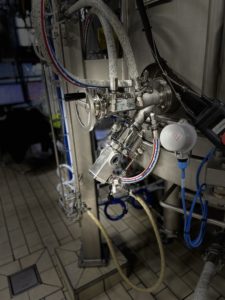
FAMAT’s high-containment sampling solution, featuring a split butterfly valve (SBV) interface, delivers up to OEB5-level containment within a compact, modular design.
Engineered for seamless integration on reactors, dryers, and mixers, it ensures aseptic, contamination-free sampling even in the most confined or sensitive production environments.
Solution Configuration and Key Benefits
-
✅ OEB4/5-compliant containment for HPAPI and cytotoxic compounds
-
✅ Operator-safe sampling through a fully sealed and automated transfer interface
-
✅ Compact footprint, easily adaptable to existing process lines and gloveboxes
-
✅ Reduced cleaning and validation workload thanks to smooth, crevice-free internal design
-
✅ Robust stainless-steel construction suitable for CIP/SIP and steam sterilization
-
✅ Modular and scalable concept, compatible with various SBV or containment systems
Conclusion
By combining precision engineering and process safety, FAMAT simplifies HPAPI sampling and containment — delivering reliability without the complexity of full isolator systems.
💡 Looking to optimize your HPAPI containment strategy?
Let’s design your next-generation sampling solution together.
Frequently Asked Questions
What is high-containment sampling?
High-containment sampling is the process of collecting product samples while minimizing operator exposure and preventing product contamination. It is commonly used for HPAPIs, cytotoxic compounds and other highly potent pharmaceutical ingredients.
What are HPAPIs?
HPAPIs (Highly Potent Active Pharmaceutical Ingredients) are pharmaceutical compounds that remain biologically active at very low doses. Because of their potency, they require specialized containment systems to protect operators during manufacturing and sampling.
What does OEB4/OEB5 mean?
OEB (Occupational Exposure Band) defines the level of operator protection required when handling hazardous pharmaceutical compounds. OEB4 and OEB5 correspond to highly potent substances that require advanced containment solutions and closed handling systems.
Why is high-containment sampling important?
High-containment sampling protects operators from exposure to hazardous powders while maintaining product integrity. It also helps manufacturers comply with occupational safety requirements and Good Manufacturing Practices (GMP).
What is a split butterfly valve (SBV)?
A split butterfly valve (SBV) is a containment interface that enables the safe transfer of powders between process equipment and containers while minimizing operator exposure and preventing cross contamination.
Can high-containment sampling systems be integrated into existing equipment?
Yes. Modern sampling systems can often be integrated into reactors, dryers, mixers and other powder handling equipment without requiring major process modifications.
Which industries use high-containment sampling?
High-containment sampling is widely used in:
- Pharmaceutical manufacturing
- Biopharmaceutical production
- HPAPI manufacturing
- Cytotoxic drug production
- Fine chemicals
- Highly potent chemical processes
What are the benefits of enclosed sampling systems?
Enclosed sampling systems help:
- Reduce operator exposure
- Improve contamination control
- Maintain product sterility
- Simplify cleaning and validation
- Increase process reliability
- Support regulatory compliance
Is high-containment sampling compatible with CIP/SIP systems?
Yes. Many high-containment sampling valves are designed for Clean-in-Place (CIP) and Steam-in-Place (SIP) processes, allowing efficient cleaning and sterilization without dismantling the equipment.