Introduction
In pharmaceutical and chemical manufacturing, cross-contamination is one of the most dangerous and costly process failures. It can compromise product quality, trigger batch recalls, and pose serious health risks, especially in HPAPI environments or multiproduct facilities. Yet during sampling, one of the most routine operations, contamination often goes unnoticed until it’s too late.
Sampling involves temporarily interrupting containment to collect product, which, if not properly managed, becomes a prime entry point for airborne particles, product residue, or cleaning chemical backflow. Dead zones in valve bodies, poor cleanability and inadequate bottle handling can increase this risk.
Common Causes of Cross-Contamination in Sampling
System design can create many cross-contamination risks during sampling. Operators do not cause every event. Poor valve design, aging seals, or incompatible cleaning protocols can introduce contaminants that affect product purity or expose operators to hazardous substances.
The most common causes include:
- Dead zones inside the valve where product accumulates and degrades over time
- Seals and O-rings that wear down, shed particles, or create microleaks
- Difficult-to-clean interfaces between the valve and the sampling bottle
- Open bottle handling, exposing product to airborne particles or glove contact
- Lack of purge capability, preventing pressure equalization and drawing contaminants inward
- Reused bottles or hoses, especially without proper sterilization between batches
Even if procedures are followed perfectly, design flaws like these make cross-contamination likely. The solution lies in smarter engineering, not just better cleaning.
Engineering Controls to Minimize Contamination Risk
Preventing cross-contamination starts with the design of the sampling system itself. Equipment must be engineered not only for performance, but for hygiene, repeatability, and complete isolation during operation. At FAMAT, this is where we focus most of our innovation.
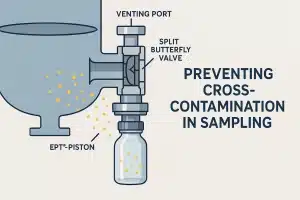
One of the most effective design features is our Expanding Piston Technology (EPT®), which creates a seal directly between the piston and valve body, without O-rings. This eliminates the risk of elastomer wear, dust shedding, and microgaps where product can accumulate. When the piston is in the closed position, it’s completely flush with the vessel wall, ensuring zero dead space.
Surface finish is another critical factor. FAMAT valves are machined to an internal roughness of Ra ≤ 0.8 µm, with options down to Ra ≤ 0.4 µm upon request. This smooth surface resists residue buildup and allows for more effective cleaning.
For operations requiring sterility or high containment, our valves can be equipped with split butterfly valves that isolate both the sampling bottle and valve outlet. Combined with venting ports and purge options, this enables clean, controlled pressure equalization before opening the system, dramatically reducing exposure and contamination risk.
Cleaning, Validation & Documentation Protocols
Even the most hygienically designed valve can become a contamination risk without proper cleaning and validation procedures. That’s why CIP (Clean-in-Place) and SIP (Sterilize-in-Place) compatibility is non-negotiable for any sampling system used in GMP environments.
FAMAT valves are engineered to allow full access for cleaning media through integrated cleaning ports. Whether cleaning is automated or manual, the flush piston design and dead-zone-free architecture ensure that no residue is left behind. For more intensive needs, models like the Tri-Clamp “easy clean” series enable rapid disassembly without special tools, so inner components can be visually inspected, cleaned, or autoclaved between batches.
From a compliance perspective, documentation is just as important. Our valves come with:
-
Material traceability certificates (EN10204 3.1)
-
FDA approval declarations for wetted seals and elastomers
-
Validation support for cleaning protocols
This level of
Bottle & Interface Handling: Small Detail, Big Impation doesn’t just happen inside the valve, it often occurs at the connection point between the valve and the sampling bottle. Poorly secured bottles, exposed threads, or reused containers can compromise an otherwise sterile process.
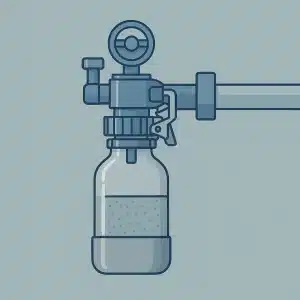
FAMAT addresses this through secure, sealed bottle interfaces available in multiple formats: Bayonet, Tri-Clamp, and GL45 thread, depending on process needs. All bottle contact materials are FDA-approved and available in borosilicate glass with stainless steel protection or fully enclosed metallic designs for high-containment scenarios.
Additional safety features include:
-
Venting valves for pressure equalization before disconnecting
-
Purge connections to eliminate trapped air or particulates
-
Mechanical locking systems prevent bottle removal until the valve fully closes
These engineering details are essential for avoiding contamination caused by handling or transfer, and for protecting both your product and your people.
High-Risk Use Cases: When Containment Matters Most
Cross-contamination during sampling is a universal risk, but in certain manufacturing environments, its consequences can be far more severe. This is especially true in the production of highly potent APIs (HPAPIs), where even minimal exposure can endanger operators and compromise product safety. In multiproduct facilities, residual traces from a previous batch can jeopardize the integrity of the next, making proper isolation essential. Cleanroom and aseptic processing zones also demand high standards, as any breach in sterility can result in significant product loss and regulatory consequences.
Facilities operating in explosive or hazardous environments governed by ATEX regulations face an added layer of complexity. Here, every component must meet strict material and performance standards to ensure safety and compliance. In all of these cases, the choice of sampling equipment can make or break the integrity of the process. FAMAT designs valve configurations with robust sealing systems for high-containment OEB 5 applications.
How FAMAT Solves Cross-Contamination Challenges
FAMAT goes beyond standard valve manufacturing. Our engineering process begins with a clear objective: reduce contamination risks at the sampling point.
FAMAT uses Expanding Piston Technology (EPT®) to replace traditional product-contact O-ring seals with a piston that expands in its closed position to create the sealing contact. When closed, the piston sits flush with the vessel wall. This design minimises dead space and product-retention areas at the process connection.
FAMAT offers CIP/SIP-compatible valve designs and Tri-Clamp EasyClean options that support rapid disassembly and visual inspection. Bayonet, GL45 and Tri-Clamp connections secure the sampling bottles. Venting and purging options can support pressure management and product isolation where the application requires them.
Mechanical locking options can prevent operators from removing the sample container before the system reaches its closed position.
FAMAT works with engineering teams, integrators and equipment manufacturers to configure valves for complex process environments. Whether the application involves a compact R&D line or a high-containment production facility, FAMAT tailors the sampling configuration to the material, process conditions and containment requirements.
The project team must evaluate and validate cleaning, sterilisation and containment performance for the complete installation.
Conclusion
Cross-contamination represents a significant risk in pharmaceutical and chemical sampling. Engineering teams can reduce this risk by selecting appropriate equipment, defining effective cleaning procedures and validating the complete sampling process.
FAMAT eliminates these risks by embedding compliance, hygiene, and safety directly into the valve’s architecture. With decades of expertise, proven performance in critical applications, and a strict focus on GMP-ready designs, we help manufacturers operate with confidence at every stage of production.