Introduction
When making lithium-ion batteries, manufacturers pick different cathode materials based on how well the battery needs to perform, how much it costs, how safe it is, and where the materials come from. For electric cars, two main types are used right now : lithium iron phosphate (LFP) and nickel-based ones, mostly nickel manganese cobalt oxide (NMC) and nickel cobalt aluminum oxide (NCA).
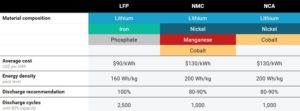
LFP batteries don’t have nickel or cobalt in their cathode material. They’re usually chosen because they’re more stable when heated, last for many charging cycles, and cost less. Nickel-based cathodes are often used when the battery needs to store more energy. The U.S. Department of Energy says that LFP and NMC are still the main types of lithium-ion batteries. LFP is known for being safer, while NMC is known for having a higher energy density.
Where these batteries are used also varies by region. LFP batteries are particularly common in China, while nickel-based batteries have historically been more popular in Europe and North America. But this difference is becoming smaller as LFP batteries are being used more outside of China. Data from the International Energy Agency in 2024 shows that the types of cathode materials used are still strongly linked to the car markets and manufacturing plans in different regions.
Sampling Considerations for LFP Cathode Powder
No matter the type of material, how well the cathode performs depends on having very specific material qualities. For LFP powder, things like the size of the particles, the exact chemical makeup, how much moisture is in it, how much it packs down, and whether each batch is consistent can all be part of how quality is checked. A lab test only matters if the sample taken actually represents the material being used in production.
So, taking a good sample is an important part of the production and quality control process. Where the sample is taken from, how the powder flows, how much powder is collected, the design of the equipment, and the conditions during sampling can all impact how accurate the sample is. This study looks at how a system for sampling LFP cathode powder can be part of a closed production process, while also dealing with issues like material separating, getting contaminated, and keeping workers safe.
Sources : Yu et al., Nature Communications, 15 July 2025, International Energy Agency, regional battery chemistry data, updated 8 April 2025, Journal of Electrochemical Energy Conversion and Storage, 2021
The Application
The process for making LFP cathode active material involves several steps: synthesis, heat treatment, milling, sorting, mixing, and handling. How it’s done depends on the company and the specific powder properties needed.
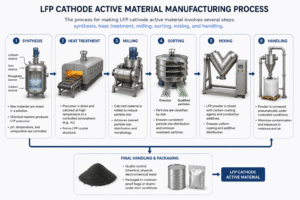
In this case, the finished LFP powder moves from a mixer or a temporary storage container to the final packaging area. Before the batch can be released or moved on, quality control samples need to be taken to make sure the material meets the set standards. These tests might check for things like particle size, moisture level, chemical makeup and any impurities, how much space the powder takes up, and how evenly mixed it is.
Just taking a sample from the top of a container or after the powder has settled won’t give a true picture of the whole batch. Differences in particle size, weight, or how the powder flows can cause it to separate as it’s being loaded, moved, or emptied.
Selecting the LFP Sampling Point
That’s why the suggested sampling point is placed right on the processing equipment, ideally where the powder is actively moving in a predictable way. This could be:
- under a mixer
- on a storage bin
- in a gravity-fed transfer line
- just before the final packaging
The goal is to grab a specific amount of LFP powder without opening up the equipment and with as little disruption to the powder flow as possible. The sampling spot also needs to be safe for taking samples, easy to clean, and accessible for checks or repairs.
We can’t decide on the exact best spot based on the powder alone. It requires looking at the shape of the equipment, how the powder moves, how big the batches are, the order of operations, and what the lab tests are for.
So, getting a truly representative sample needs to be part of the production and quality control plan. Factors like where the sample is taken, how the powder flows, how much powder is sampled, the equipment design, and the conditions during sampling can all impact the sample’s accuracy. This study looks at how to set up a sampling system for LFP cathode powder within a closed process, while also dealing with powder separation, contamination, and keeping workers safe.
The Sampling Challenge
Sampling LFP cathode powder involves more than collecting a small quantity of material from the process. The sample should represent the material at the selected process stage and provide reliable material for laboratory analysis.
Several factors can influence sample quality.
Particle Segregation
Powder particles can differ in size, shape and density. During transfer or hopper discharge, these differences can cause particles to follow different flow paths or accumulate in specific areas.
A sample from an unsuitable location may therefore represent only one fraction of the powder rather than the material moving through the process. This becomes particularly important when particle size distribution forms part of the product specification.
Powder Flow Behaviour
The sampling chamber needs to fill and discharge consistently during each sampling cycle.
Cohesive behaviour, bridging, compaction or poor flowability can affect the quantity of powder entering the chamber. These characteristics can also prevent complete discharge into the sample container.
Testing with the actual LFP powder can help evaluate filling and discharge behaviour under representative process conditions. Particle size alone does not provide enough information to predict powder flow inside the sampling device.
Moisture Exposure
Moisture can affect the condition of LFP cathode materials. The sampling procedure should therefore limit unnecessary contact with ambient air when moisture or surface condition forms part of the product specification.
A closed sampling path can limit atmospheric exposure between the process and the receiving container. The manufacturer’s material specifications and process conditions should determine the required level of protection.
Contamination Risk
Contamination can originate from residual material from a previous batch, incompatible product-contact materials, external particles or sample handling.
The sampling strategy should therefore consider:
- Product-Contact Materials
- Surface Condition
- Residual Product
- Cleaning Procedure
- Sample-Container Connection
- Permitted Metallic Contamination
- Cross-Contamination Limits
The battery-material producer should define the acceptable contamination and carryover limits.
Operator Exposure
Opening a process connection or manually collecting powder can release fine particles into the working environment.
A closed sampling system can reduce manual handling and maintain a controlled path between the process and the sample container.
However, the required containment level depends on the actual material, workplace exposure limits and site-specific risk assessment. The designation LFP powder alone does not determine the required containment performance.
Sampling Repeatability
Samples collected at different locations, at different stages of batch transfer or according to different operating procedures may produce different laboratory results.
A defined sampling point, consistent sample quantity, controlled sampling sequence and standardized operating procedure can improve repeatability between successive samples.
💡 Engineering Insight
A precisely machined sampling valve cannot compensate for a poorly selected sampling location. Representative sampling depends on the interaction between the powder, the process flow, the equipment and the sampling procedure.Looking for a reliable powder sampling valve for battery materials?
Discover how FAMAT helps manufacturers minimize contamination risks while improving sample integrity and operator safety.
Why Representative Sampling Matters
Laboratory equipment can only analyse the material it receives. Even highly accurate analytical methods cannot compensate for a sample that does not adequately represent the process material.
For LFP cathode powder, the sampling method can directly influence the reliability of several quality parameters.
Particle Size
Particle size distribution influences powder handling and electrode manufacturing. During transfer, differences in particle size can cause segregation. A sample taken from only one location may therefore provide a different particle size distribution from the material moving through the overall process.
Chemical Composition and Impurities
Chemical analysis often uses only a small quantity of material. Local variations within the powder or contamination introduced during sampling can therefore affect the reported composition.
This becomes particularly important when quality specifications impose strict limits on certain elements or metallic impurities.
Moisture Content
LFP powder can interact with ambient moisture during sampling and subsequent handling. Environmental exposure can therefore change the condition of the sample before laboratory analysis.
The sampling system, receiving container and handling procedure should limit this exposure when moisture forms part of the quality specification.
Bulk and Tapped Density
Particle distribution, powder settling and sample handling can influence bulk and tapped density measurements.
Excessive vibration, compaction or inconsistent filling of the sample container may alter the condition of the collected powder. The sampling and handling procedure should therefore maintain consistent conditions between samples.
Batch Homogeneity
A single sample provides information about the material present at one location and at one point in time.
Depending on the sampling objective, the sampling plan may require several increments from different stages of the process or batch discharge. The laboratory can analyse these increments individually or combine them into a composite sample.
The sampling plan should define the number of increments, sampling frequency and method used to prepare the final laboratory sample.
ISO 14488 provides guidance on sampling and sample division for particulate materials and highlights the relationship between sampling, sample preparation and the properties under investigation.
💡 Engineering Insight
Sampling should be designed backwards from the laboratory objective. The property being measured determines how the sample must be collected, protected, divided and transported.
Proposed Sampling Approach
For this application, the process equipment integrates the sampling system directly at the selected sampling point. The objective is to collect a defined quantity of LFP powder under controlled conditions while maintaining a closed product path.
Sampling from Moving Powder
Whenever possible, the sampling point should access powder while it moves through the process.
Sampling from a moving stream provides access to material passing the sampling location at different moments during the batch and can reduce reliance on material from a single static location.
However, powder flow still influences representativeness. Hopper geometry, preferential flow channels, stagnant areas and particle segregation can affect the material reaching the sampler.
The sampling location should therefore reflect the process stage that the laboratory result needs to evaluate.
Defined Sample Volume
A sampling chamber with a fixed internal volume provides a repeatable nominal sampling capacity.
The appropriate chamber size depends on:
- Required Laboratory Sample Quantity
- LFP Powder Bulk Density
- Powder Flowability
- Chamber Filling Behaviour
- Required Number of Increments
- Laboratory Sample Preparation Procedure
Nominal chamber volume alone does not determine the actual collected mass. Powder density and chamber-filling efficiency also influence the quantity obtained during each sampling cycle.
When the laboratory requires a larger quantity, the sampling procedure can collect several increments rather than relying on a single oversized chamber.
💡 Engineering Insight
A defined chamber volume improves repeatability only if the chamber fills and empties consistently. Testing with the actual powder remains essential.
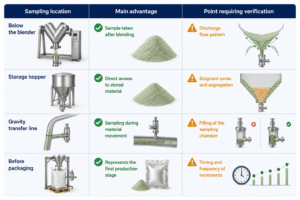
Selecting the Sampling Location
The sampling location directly influences the quality and relevance of the collected sample. The purpose of the analysis and the powder behaviour throughout the process should guide the selection of the sampling point.
For LFP cathode powder, several process locations can provide useful sampling opportunities.
Below a Blender
Installing the sampling valve below a blender provides access to the powder immediately after the blending operation.
This location can help evaluate final blend homogeneity before the powder moves to the next production stage.
The sampler should access the main powder flow and avoid stagnant areas near the outlet that may not adequately represent the discharged material.
On a Storage Hopper
A sampler installed on a storage hopper provides direct access to the stored powder.
However, material close to the hopper wall may differ from powder moving through the central flow channel. Hopper geometry, flow pattern and potential segregation can influence the composition of the material reaching the sampling point.
The sampling strategy should therefore consider the internal hopper geometry and discharge behaviour before selecting this location.
On a Gravity Transfer Line
A gravity transfer line can provide a suitable sampling location when the objective is to collect increments during product transfer.
The installation should account for:
- Pipe Diameter
- Installation Angle
- Powder Velocity
- Available Installation Space
- Chamber Filling Behaviour
- Risk of Product Retention
- Main Powder Flow
The selected geometry should allow the sampling chamber to fill consistently without significantly obstructing the main product flow.
Before Final Packaging
Sampling immediately before packaging provides information about the material at the final stage of production.
This location can also support the collection of several increments during the filling sequence, depending on the process configuration.
However, the sample represents the material entering the packaging system at that specific stage. It does not necessarily identify the origin of an earlier process variation or contamination event.
Recommended Approach for This Application
For the application considered here, the preferred starting point would be either:
- below the final blender, if the objective is to verify blend homogeneity
- on the gravity transfer line before packaging, if the objective is to represent the discharged batch
The final selection requires a review of the actual process drawings, powder flow direction, sampling frequency and required laboratory quantity.
💡 Engineering Insight
There is no universally representative sampling point. The correct location depends on which stage of the process the laboratory result is intended to represent.
The proposed configuration is intended to improve the control and consistency of the sampling operation. The benefits listed below are functional expectations and must be confirmed during commissioning and process validation.
More Consistent Sampling
A fixed sampling location and defined chamber volume can reduce variations caused by operators using different tools, quantities or collection methods.
Consistency still depends on complete chamber filling, reliable discharge and a clearly defined operating procedure.
Reduced Open Handling
Collecting the sample directly from closed process equipment can reduce the need to open a hatch, access the powder surface or transfer material manually.
This can help limit powder release into the working environment and reduce opportunities for external contamination.
Improved Sample Protection
A closed connection between the sampling valve and the receiving container can limit exposure to ambient air and moisture.
The degree of protection depends on the complete sampling arrangement, including the container, seals, connection method and handling after collection.
Lower Cross-Contamination Risk
A sampling system designed for inspection and cleaning can help control residual material between batches or sampling sequences.
The battery-material producer should define the acceptable carryover limit and the method used to verify cleaning performance.
Integration into the Process Sequence
An actuator can integrate the sampling valve into the production control system and trigger sampling at predefined stages of the batch transfer.
This approach can support:
- Collection at Defined Time Intervals
- Multiple Increments Across a Batch
- Consistent Valve Operating Sequences
- Traceability of Sampling Events
Automation alone does not guarantee representative sampling. The sampling sequence should correspond to actual product flow, and the sampler should operate consistently under representative process conditions.
Better Operator Protection
A closed sampling procedure can reduce direct contact between the operator and fine LFP powder.
The complete installation and the site’s occupational health requirements should determine the required level of containment. Appropriate testing should verify the containment performance where specific performance levels are required.
💡Engineering Insight
The main benefit of an integrated sampling valve is greater control over how, where and when the sample is collected. Its performance must still be demonstrated with the actual powder and process.
Engineering Considerations
Before selecting the final sampling configuration, the powder characteristics, process conditions and analytical requirements must be reviewed together.
| Parameter | Why it matters | Information required |
| Particle size distribution | Influences segregation and chamber filling | Typical range and proportion of fine particles |
| Particle morphology | Affects friction, cohesion and flow behaviour | Shape and surface characteristics |
| Bulk density | Determines the approximate sample mass obtained from a defined volume | Loose and, if relevant, tapped density |
| Flowability | Influences chamber filling and sample discharge | Evidence of bridging, sticking or compaction |
| Moisture sensitivity | Determines the required protection from ambient air | Maximum exposure and permitted moisture level |
| Process temperature | Affects seals, handling and powder behaviour | Normal and maximum temperatures |
| Process pressure | Determines valve and actuator requirements | Normal, maximum and differential pressure |
| Required sample quantity | Defines chamber volume or number of increments | Minimum mass needed for each analysis |
| Sampling frequency | Influences manual or automated operation | Samples per batch or time interval |
| Contact-material requirements | Helps control chemical or metallic contamination | Approved materials, seals and surface finish |
| Cleaning method | Influences valve design and accessibility | Dry, wet, manual or integrated cleaning |
| Containment requirement | Determines the sample-container interface | Risk assessment and exposure limits |
Powder Testing
When flow behaviour is uncertain, testing should be performed with a representative quantity of the actual LFP powder. A substitute powder with a similar nominal particle size may behave differently because of variations in morphology, moisture, surface condition or electrostatic properties.
Testing should verify:
- entry of the powder into the sampling chamber
- consistency of the collected mass
- complete sample discharge
- product retention after operation
- operation across the expected process conditions
- cleaning between samples or batches
Sampling Plan
The sampling plan should complement the mechanical design and define:
- The Purpose of Each Sample
- The Selected Sampling Point
- The Timing of Sample Collection
- The Number of Sampling Increments
- The Method for Analysing or Combining Increments
- The Container and Identification Method
- Storage and Transport Conditions
- The Laboratory Sample-Division Procedure
💡Engineering Insight
A sampling valve provides the mechanical means of collecting material. Representative results require the valve, sampling plan and laboratory procedure to function as one complete system.
Conclusion
Representative sampling of LFP cathode powder requires more than selecting a valve with an appropriate connection size. The complete sampling system must reflect the characteristics of the powder, the process flow, the purpose of the analysis and the required level of containment.
A sampling valve installed directly on a blender, hopper or transfer line can provide a controlled method for collecting a defined quantity of powder. However, the selected location must correspond to the process stage that the laboratory result needs to represent.
A successful installation requires consideration of the following elements:
- Particle size distribution and powder flowability
- Bulk density and required sample mass
- Risk of segregation during transfer
- Moisture and contamination limits
- Sampling point and operating sequence
- Chamber filling and discharge behaviour
- Product-contact materials
- Sample-container connection
- Cleaning and inspection requirements
- Manual or automated operation
When filling, discharge, retention or flow behaviour remains uncertain, we recommend testing the actual LFP powder.
By integrating the sampling device into the process and defining a consistent sampling procedure, manufacturers can better control sample collection and protection before laboratory analysis.
Discuss Your LFP Powder Sampling Application
Every battery-material process has different powder characteristics, equipment geometry and analytical requirements.
FAMAT Sampling can review your application according to:
- Powder properties
- Process conditions
- Required sample quantity
- Preferred sampling location
- Containment requirements
- Cleaning procedure
- Manual or automated operation