APPLICATION CASE STUDY | GRAPHITE-CATHODE POWDER SAMPLING
The Application
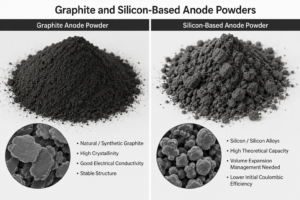
Graphite and cathode powders play different roles in lithium-ion batteries, but both require controlled sampling throughout the manufacturing process.
Graphite is widely used as an anode material, while cathode materials such as NMC (Nickel Manganese Cobalt), LFP (Lithium Iron Phosphate), NCA and LMFP contribute to key battery characteristics and performance.
Sampling may be required at several stages of battery material production, including:
- Incoming raw material inspection
- Reactor sampling
- Mixer verification
- Spray dryer monitoring
- FInal product quality control
- Recycling process monitoring
In this application, the objective is to integrate powder sampling directly into the manufacturing process, allowing material to be collected at a defined process location for laboratory analysis and quality control.
The sampling concept must take into account the powder characteristics, required sample volume and process conditions at the selected sampling point.
💡 Engineering Insight: Sampling at a defined process location provides information about the material present at that specific stage of production. The sampling location should therefore be selected according to what the sample is intended to represent.
The Challenge
Collecting battery powder is relatively simple. Obtaining a controlled sample that is suitable for the intended analysis requires greater attention to the sampling conditions.
Graphite and cathode materials can have significantly different physical and handling characteristics. Particle size, bulk density, flowability, electrostatic behaviour and environmental sensitivity can influence how the powder enters, fills and leaves a sampling chamber.
The sampling system therefore needs to address several practical requirements:
- Controlled interaction with the powder flow
- Consistent filling of the sampling chamber
- Controlled sample volume
- Limited product retention
- Controlled discharge into the sample container
- Reduction of unnecessary dust exposure
- Limitation of unwanted carryover between samples
- Integration into existing process equipment
These considerations become particularly relevant with fine graphite powders and high-value or potentially hazardous cathode materials.
💡 Engineering Insight: The same sampling chamber can behave differently with different battery powders. Sampling performance should therefore be evaluated according to the actual material rather than nominal chamber volume alone.
Sampling Challenges for Graphite Powders
Graphite powders present specific handling characteristics that can influence sample collection.
Lightweight Powders
Fine graphite powders may have relatively low bulk density and can become airborne when disturbed. Powder behaviour around the sampling point should therefore be considered when positioning and operating the sampling system.
Dust Generation
Fine graphite particles can generate dust during handling and sampling. A controlled sampling path and appropriate sample collection method can help limit unnecessary release of powder into the surrounding environment.
Electrostatic Behaviour
Dry graphite powders may accumulate electrostatic charges during handling. This can influence powder movement and adhesion to surfaces and, consequently, filling and discharge of the sampling chamber.
The sampling configuration should therefore be evaluated with the actual graphite powder whenever its flow behaviour is difficult to predict.
💡 Engineering Insight: With fine graphite powders, successful sampling depends not only on extracting material from the process but also on reliable chamber filling and discharge. Adhesion or electrostatic effects can influence the quantity actually reaching the sample container.
Sampling Challenges for Cathode Materials
Cathode materials introduce a different combination of sampling considerations, particularly regarding operator exposure, environmental sensitivity, cross-contamination and product value.
Potentially Hazardous Powders
Nickel- and cobalt-containing materials may require controlled handling according to the applicable exposure requirements. The sampling concept should therefore consider containment throughout sample collection and transfer.
Moisture Sensitivity
Some cathode materials can be sensitive to atmospheric moisture. Where this is relevant, exposure to the surrounding environment during sampling and sample transfer should be minimized according to the process requirements.
Cross-Contamination
Manufacturing different battery chemistries on shared or adjacent equipment requires careful control of residual material. Sampling equipment should therefore minimize areas where powder can accumulate and allow an appropriate cleaning strategy to be implemented.
Product Value
Cathode materials can represent a high-value process material. Limiting unnecessary retention and loss during sampling can therefore be an additional consideration when selecting the sampling system.
💡 Engineering Insight: Graphite and cathode materials should not automatically be treated as equivalent sampling applications. Powder behaviour, exposure requirements, environmental sensitivity and cleaning strategy can lead to different sampling configurations.
The FAMAT Sampling Approach
Select the sampling valve according to the material behaviour and process conditions rather than simply according to the connection size or required nominal sample volume.
For battery powder applications, relevant design considerations include:
- Controlled sample collection
- Closed sample transfer where required
- Reliable sealing
- Minimal internal dead spaces
- Limited powder retention
- Accessibility for cleaning
- Suitable product-contact materials
- Robust stainless-steel construction
- Compatibility with manual or automated production processes
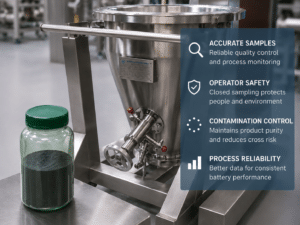
FAMAT designs powder sampling valves for direct integration into process equipment. These valves allow operators to extract a defined quantity of material from the powder stream.
The appropriate configuration depends on the powder characteristics, process geometry, sample volume, containment requirements and cleaning strategy.
💡 Engineering Insight: A larger sampling chamber does not necessarily provide a better sample. Chamber geometry, filling behaviour and complete discharge should be considered together when selecting the sampling configuration.
Operational Benefits
Integrating a dedicated sampling system into battery powder processing can support several quality-control activities, including:
- Incoming material inspection
- Process monitoring
- Mixer or batch verification
- Quality assurance
- Batch certification
- Contamination-control strategies
- Operator-protection strategies
- Final product evaluation
Direct process sampling can also reduce the need for operators to manually access the powder at certain process stages.
The manufacturing team should define the sampling frequency, sample volume and sampling locations according to the manufacturing process and the purpose of the subsequent analysis.
💡 Engineering Insight: Sampling equipment is one component of the overall quality-control strategy. Representative sampling ultimately depends on the combination of equipment design, sampling location, sampling frequency, powder behaviour and the defined sampling procedure.
FAMAT Sampling Solution
For more than 50 years, FAMAT has developed powder sampling valves for pharmaceutical, chemical and other demanding powder-processing applications, including battery materials.
For graphite and cathode powder processes, configure the sampling system according to the material characteristics and installation requirements.
Depending on the application, the objective may include:
- Collecting Controlled Powder Samples Directly from the Process
- Limiting Exposure of the Powder to the Surrounding Environment
- Reducing Product Retention Within the Sampling Path
- Facilitating Cleaning Between Products or Batches
- Providing Controlled Transfer into the Sample Container
- Integrating Sampling into Manual or Automated Production Equipment
Select the final configuration according to the actual powder, installation geometry, process conditions and sampling objective.
💡 Engineering Insight: Product trials can be useful for fine, cohesive or electrostatically sensitive battery powders. Similar powders can behave differently inside the same sampling system, making actual product behaviour an important part of sampler selection.
Conclusion
Graphite and cathode powders present different sampling challenges, from dust generation and electrostatic behaviour to environmental sensitivity, operator exposure and cross-contamination control.
Manufacturers should therefore select a process sampling system according to the material and the specific objective of the sample.
By integrating sampling directly into the process, manufacturers can collect material at defined production stages while maintaining a controlled sampling path and limiting unnecessary product handling.
The complete sampling strategy must evaluate the representativeness of the final sample, including the sampling location, frequency, process conditions and subsequent sample handling.
Discuss Your Battery Powder Sampling Application
Graphite, NMC, LFP, NCA and other battery materials can require different sampling configurations depending on their physical properties and process conditions.
Contact our team to discuss your battery powder sampling application and identify the most suitable sampling solution for your process.
Frequently Asked Questions
Why do graphite and cathode powders require different sampling approaches?
Graphite and cathode materials have different flow characteristics, particle properties and handling requirements. Sampling systems should be adapted to these differences to obtain representative samples.
Why is representative powder sampling important?
Representative sampling ensures that laboratory analyses accurately reflect the properties of the entire production batch.
Why are enclosed sampling valves preferred?
Closed sampling valves reduce contamination risks, limit operator exposure and improve sample repeatability.
Which battery materials can be sampled?
Sampling valves are commonly used for graphite, NMC, LFP, NCA, LMFP, lithium compounds and recycled battery powders.
What are the benefits of closed powder sampling?
Closed powder sampling improves contamination control, operator safety, product integrity and process reliability.