Crust Breaking Sampling Valve for Powder Dryers and Process Vessels
Introduction
Obtaining a representative sample can become difficult when powders form hard crusts on the internal walls of dryers, reactors or process vessels.
These deposits can completely block the inlet of a conventional sampling valve, preventing material from reaching the sampling chamber and resulting in unreliable or impossible sampling.
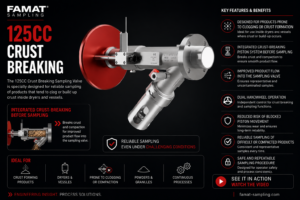
The FAMAT Crust Breaking Sampling Valve has been specifically developed to mechanically break these hardened layers immediately before sampling, restoring product flow while maintaining the integrity of the process.
Typical Process Challenge
Many industrial powders progressively build a compact layer on vessel walls because of:
- moisture
- drying cycles
- temperature variations
- sticky ingredients
- product compaction
- long production campaigns
Over time, this crust grows until it covers the sampling point.
When a standard sampling valve is opened, little or no product reaches the sampler, making representative sampling impossible.
How the Crust Breaking Valve Works
The FAMAT design incorporates a dedicated mechanical crust breaker positioned directly in front of the sampling port.
Immediately before the sampling cycle, the breaker penetrates and fractures the hardened layer.
Fresh product located behind the crust can then flow naturally into the sampling valve, allowing representative samples to be collected without manual intervention.
The mechanism operates directly from outside the process, eliminating the need to open the vessel.
Typical Applications
The Crust Breaking Sampling Valve is commonly used on:
- spray dryers
- fluid bed dryers
- vacuum dryers
- reactors
- silos
- hoppers
- process vessels
where hardened deposits periodically obstruct the sampling point.
Key Benefits
- Reliable sampling despite hardened deposits
- Representative samples from the product flowing behind the crust
- Eliminates manual cleaning before sampling
- Reduces operator intervention
- Improves process availability
- Suitable for pharmaceutical, food and chemical industries
- Can be integrated with FAMAT sampling systems
Engineering Insight
Breaking the crust immediately before sampling is generally more effective than periodically cleaning the vessel wall. The sampling point remains functional throughout the production campaign while reducing operator exposure and downtime.
Frequently Asked Questions
Why does product stop flowing into a sampling valve?
Some powders progressively form a hard compact layer against the vessel wall. This layer blocks the sampling inlet and prevents product from entering the valve.
Does the crust breaker damage the product?
No. The mechanism only fractures the hardened layer immediately surrounding the sampling point to restore normal product flow.
Can it be retrofitted?
In many applications, yes. The feasibility depends on the existing process connection and available installation space.
Related Videos
- 125A Standard Sampling Valve – The standard EPT® sampling valve for powders, granules, pastes and liquids.
- 125HS Horizontal Intrusive Sampler – Quantitative sampling for vertical gravity-flow pipes.
- 125AUT Automatic Sampling Valve – Automated representative sampling for continuous production.
- 125TC/OEL High Containment – Safe sampling of highly potent powders under contained conditions.
Related White Papers
- Representative Powder Sampling: Principles, Best Practices and Industrial Applications
- How to Select the Right Sampling Valve for Your Process
- Cross Contamination in Industrial Sampling
- Different Types of Sampling Valves Explained
Related Application Notes
- Sampling in Powder Dryers
- Battery Powder Sampling
- Graphite Powder Sampling
- Cathode Material Sampling